Thread count measures the number of threads woven per square inch of fabric in bed sheets. For wholesale buyers, the ideal range is typically 200 to 600, depending on fiber type and weave. Higher thread count does not always mean better quality. Factors like cotton grade, yarn type, and weave construction matter just as much — often more.
The Thread Count Myth That Is Costing Wholesale Buyers Money
If you have ever stood in a wholesale showroom or scrolled through a supplier catalog comparing 400-count and 800-count bed sheets, wondering which one gives you the best value for bulk orders, you are not alone.
Thread count has been one of the most misunderstood numbers in the textile industry for decades. Retailers from New York to Los Angeles, hotel procurement managers in Chicago, and linen distributors in Toronto have all been burned at some point by chasing a high thread count without understanding what it actually means.
The truth? A 300-thread-count sheet made from long-staple Egyptian cotton will outperform a 1,000-thread-count sheet made from low-grade, multi-ply yarn every single time. And if you are buying in bulk — whether you are restocking a chain of hotels in Texas, supplying a hospital network in the UK, or building a private-label home goods brand in Germany — understanding thread count at a technical level is not optional. It is essential.
This guide from Minmax Textile breaks down everything wholesale buyers need to know about thread count: what it means, what it does not mean, and how to use it to make smarter sourcing decisions in the USA and beyond.
What Is Thread Count, Actually?
Thread count refers to the total number of threads — both horizontal (weft) and vertical (warp) — woven into one square inch of fabric.
A sheet with 150 vertical threads and 150 horizontal threads would have a thread count of 300. Simple enough. But here is where manufacturers started playing games.
Some suppliers count each ply within a twisted, multi-ply yarn as a separate thread. So a sheet woven from two-ply yarn could be labeled as having twice the actual thread count. A fabric with a true count of 300 suddenly becomes a “600-thread-count sheet” on the packaging — without any real improvement in softness, durability, or feel.
This practice became so widespread in the mid-2000s that the Federal Trade Commission in the USA investigated several textile companies for misleading labeling. For wholesale buyers placing large orders, this kind of confusion can translate directly into customer complaints, returns, and damaged brand reputation.
Thread Count Ranges: What They Mean for Wholesale Buyers
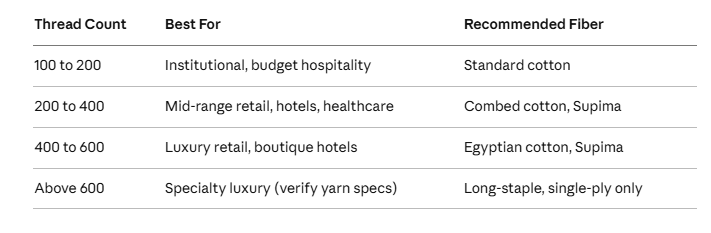
Understanding thread count tiers helps buyers match product specs to end-use needs. Here is a practical breakdown:
100 to 200 Thread Count
These are your entry-level, utility-grade sheets. They feel crisp, breathe well, and hold up to frequent industrial laundering. This range is popular for:
- Budget hospitality operations and motels
- Healthcare settings like clinics and nursing homes
- Emergency shelters and institutional housing
They are not luxurious, but they are durable and economical. If you are supplying a chain of budget accommodations across the Midwest or a hospital network in the UK, this range is cost-effective and practical.
200 to 400 Thread Count
This is the sweet spot for most wholesale buyers. Sheets in this range — especially when made from single-ply, long-staple cotton — offer a balanced combination of softness, durability, and breathability.
Hotels like Hampton Inn and Holiday Inn have standardized on a 250-300 thread count for their standard-room linen for years. There is a reason for that. It is durable enough for high-volume laundering, comfortable enough for guest satisfaction, and affordable enough to replace regularly.
For retailers building private-label sheet programs in the USA or Canada, the 300-400 range with combed or percale weave construction offers a strong value proposition.
400 to 600 Thread Count
This range enters premium territory. Done right — meaning single-ply yarns from quality cotton — sheets in this range feel noticeably softer and have a subtle sheen. They are ideal for:
- Upscale boutique hotels
- Luxury bedding retailers
- High-end e-commerce brands
This is also the range where Minmax Textile sees the most demand from wholesale buyers in Western Europe, particularly in Germany and France, where end consumers are sophisticated, and quality expectations are high.
Above 600 Thread Count
Be skeptical. Very skeptical.
A true single-ply fabric with more than 600 threads per square inch becomes physically dense, uncomfortable, and poorly breathable. Any sheet claiming 800, 1,000, or 1,200 thread count at a reasonable price is almost certainly using multi-ply yarns — meaning the actual fabric quality is nowhere near what the number implies.
This does not mean all high-count sheets are fraudulent. Some legitimate luxury brands use multi-ply for specific texture effects. But unless you are sourcing from a manufacturer who can provide technical yarn specifications, treat anything above 600 with caution.
Thread Count vs. Fiber Quality: Which Matters More?
Here is the honest answer most suppliers will not tell you: fiber quality matters more than thread count.
The two most important factors determining how a sheet feels and lasts are:
1. Cotton Grade
Long-staple cottons — Egyptian cotton, Supima (American Pima), and GIZA cotton — produce smoother, stronger yarns because the longer fibers twist together more tightly with fewer protruding ends. The result is a fabric that starts soft and gets softer with washing.
Short-staple cotton, on the other hand, produces fibers that pill quickly and become scratchy after repeated laundering. A 600-thread-count sheet made from short-staple cotton will feel noticeably worse than a 300-count sheet made from Egyptian cotton six months into use.
For wholesale buyers in the USA supplying premium retail or hospitality clients, Supima cotton is a particularly strong selling point. It is grown domestically in California and Arizona, carries a certified trademark, and resonates with American consumers who value domestically sourced materials.
2. Yarn Type: Single-Ply vs. Multi-Ply
Single-ply yarns use one thread. Multi-ply yarns twist two or more threads together. Single-ply sheets at a given thread count will be lighter, more breathable, and more durable. Multi-ply sheets at the same thread count will be heavier and denser — sometimes mistaken for quality, but often a sign of thread count inflation.
When requesting samples from suppliers, always ask for a yarn specification sheet. Any reputable wholesale textile supplier, including Minmax Textile, should be able to provide this documentation.
Weave Construction: The Third Variable Nobody Talks About
Thread count and fiber quality are two legs of the stool. Weave construction is the third, and it significantly affects the feel and function of the finished sheet.
Percale Weave
Percale uses a one-over-one-under weave pattern. It produces a crisp, cool, matte-finish fabric that is particularly popular in warm climates — think Florida, Texas, or Southern California — and among consumers who sleep hot. Percale sheets with a 200 to 300 thread count often feel comparable to sateen sheets with a 400 count.
Sateen Weave
Sateen uses a four-over-one-under pattern that exposes more yarn on the surface, creating a silky, slightly lustrous finish. It feels softer to the touch but is slightly less durable and less breathable than percale. This weave is popular in premium retail settings and is a strong choice for luxury hotel linen programs.
Twill Weave
Less common in bed sheets, but worth mentioning. Twill produces a diagonal ribbed texture. It is extremely durable and holds color well, making it a reasonable choice for high-laundry-cycle institutional settings.
Understanding weave type enables wholesale buyers to have more informed conversations with manufacturers and make more targeted product selections for specific end markets.
Practical Tips for Wholesale Buyers Sourcing Bed Sheets in the USA and Internationally
Whether you are placing your first bulk order or renegotiating an existing supplier contract, these practices will protect your business and improve your product line.
Always request physical samples before committing to bulk orders. No catalog photo or product description captures how a sheet actually feels or how it holds up to washing. Wash the sample several times before making a judgment.
Ask for third-party test reports. Reputable suppliers will have ISO, OEKO-TEX, or SGS certifications verifying fiber content, chemical safety, and quality consistency. This is especially important for buyers supplying healthcare facilities or children’s products in the USA, UK, and EU markets where regulatory standards are strict.
Understand your end market before setting thread count specs. A hotel procurement buyer in Nashville has different needs than a bedding retailer in London or a health clinic in Toronto. Do not apply a one-size-fits-all spec to every order.
Negotiate on yarn specification, not just thread count. If your supplier cannot or will not tell you whether the yarn is single-ply or multi-ply, treat that as a warning sign.
Build a quality audit process for ongoing orders. Thread count and fiber consistency can vary across production batches when there is no contractual quality assurance process in place. Minmax Textile, for example, provides batch-level quality documentation on all wholesale contracts to ensure consistency across repeat orders.
Local Insights for USA-Based Wholesale Buyers
The United States remains one of the largest wholesale bedding markets globally. A few specific dynamics are worth noting for buyers operating here.
Hotel and hospitality procurement in cities like Las Vegas, Orlando, and New York City tends to prioritize durability and cost-efficiency over a luxury feel. The 250-350 thread count range in percale weave dominates this segment.
Retail and e-commerce brands based in cities like Seattle, Austin, and Boston are increasingly targeting the premium consumer segment with private-label bedding. This market responds well to Supima or Egyptian cotton certifications and sateen weave in the 400 to 500 range.
Healthcare and institutional buyers in markets like Houston and Chicago typically prioritize chemical compliance, laundering durability, and cost. Thread count is less important here than fabric weight, weave durability, and compliance documentation.
Minmax Textile has worked with wholesale buyers across all three of these segments and can tailor product specifications and minimum order quantities accordingly.
Thread Count Cheat Sheet for Wholesale Buyers
FAQ: Thread Count for Wholesale Bed Sheets
What is a good thread count for hotel bed sheets in the USA?
For most hotel operations in the USA, a percale weave made from combed cotton with a thread count of 250 to 350 offers the best balance of durability, comfort, and cost. Luxury properties typically fall into the 400 to 500 range, with a sateen weave and Egyptian or Supima cotton.
Is a higher thread count always better quality?
No. A thread count above 600 is often achieved by counting multiple-ply yarn strands separately, which inflates the number without improving the fabric. Fiber quality, yarn type, and weave construction are equally, or often more, important than thread count alone.
What thread count is best for wholesale retail bed sheets?
For retail applications targeting the mainstream USA consumer, 300 to 400 thread count with combed cotton and percale or sateen weave is the most reliable range. For premium positioning, 400 to 500 with Supima or Egyptian cotton commands higher price points.
What certifications should I look for when buying wholesale bed sheets?
Look for OEKO-TEX Standard 100 certification (chemical safety), Supima or Egyptian Cotton Association certification (fiber authenticity), and ISO 9001 quality management certification from the manufacturer. These are particularly important for buyers supplying the USA, UK, EU, and Canadian markets.
How do I verify thread count claims from a wholesale supplier?
Request a yarn specification sheet detailing ply count, fiber origin, and yarn count. You can also send samples to an independent textile testing laboratory — SGS, Bureau Veritas, and Intertek all offer this service in the USA. Reputable suppliers like Minmax Textile welcome this kind of verification.
Conclusion: Buy Smarter, Not Just Cheaper
Thread count is a useful starting point, but it is not the whole story. The wholesale buyers who consistently deliver quality products to their customers — and build lasting supplier relationships — are the ones who understand what sits behind the number on the label.
The fiber origin, the yarn construction, the weave pattern, and the manufacturer’s quality controls collectively determine whether your customers sleep well and whether they come back to you for more. Thread count is just one data point in that equation.
At Minmax Textile, we work with wholesale buyers across the USA, UK, Canada, Germany, and France to build bedding programs that make sense for their specific markets and customer expectations. Whether you are sourcing for a 50-room boutique hotel in Nashville, a 500-location retail chain, or a healthcare network in the UK, we can help you find the right specification at the right volume.
Ready to talk thread counts, fiber specs, and bulk pricing? Contact Minmax Textile today and let us build a wholesale bedding program that actually delivers on its promises.