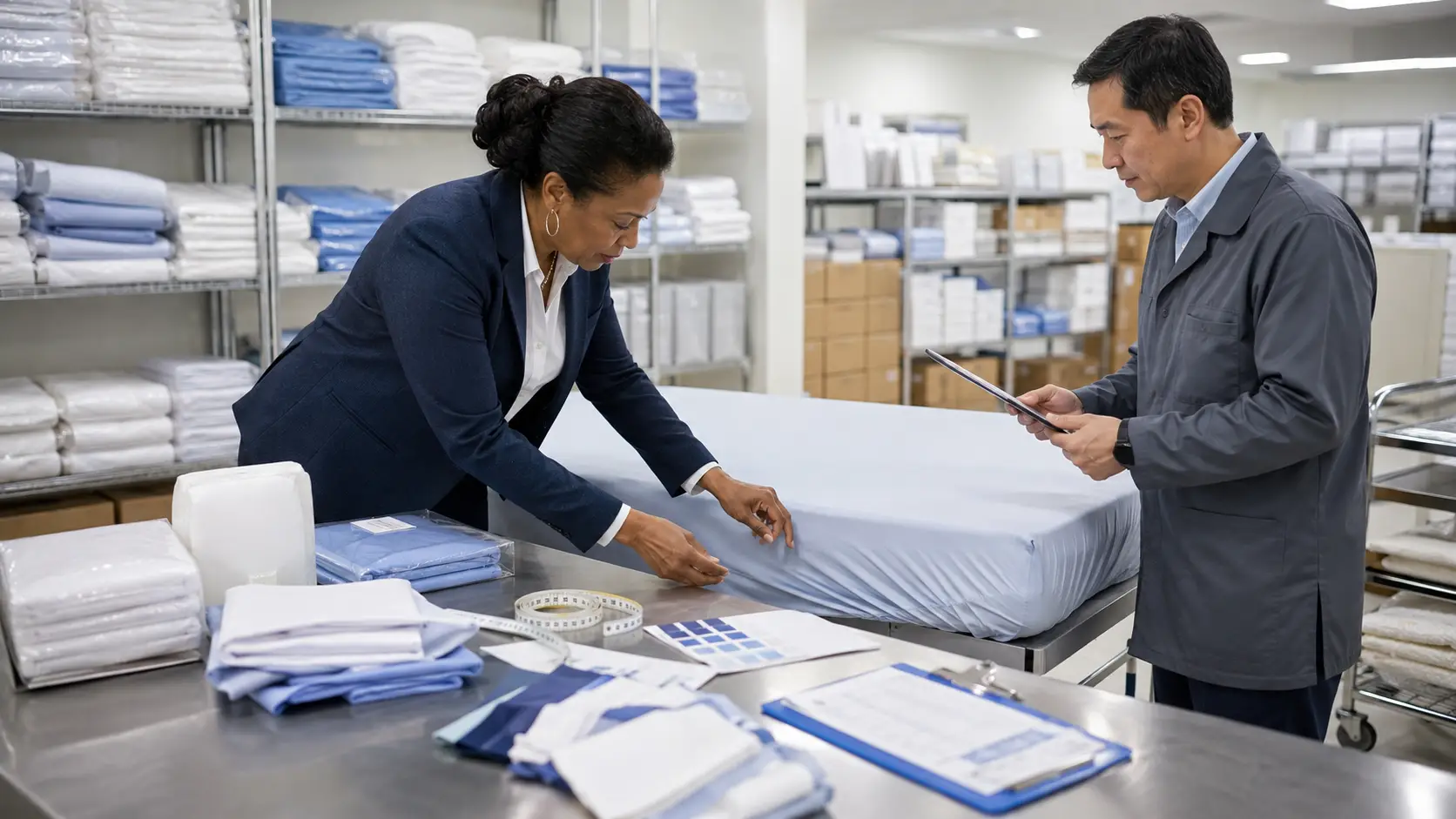
Medical bed sheets are designed for general patient care in home or clinical settings, prioritizing comfort and softness. Hospital bed sheets are a specific category engineered for institutional use — built for durability, infection control, and repeated industrial laundering. While both serve healthcare purposes, their construction, material standards, and performance requirements differ significantly.
A Question That Confuses More People Than You Think
Walk into any linen supply store in Chicago, Houston, or Los Angeles, and you will likely find shelves labeled “medical grade” and “hospital grade” bedding sitting side by side. Most buyers — whether they are purchasing for a nursing home, a home health setup, or a large hospital network — assume the two terms mean the same thing.
They do not.
If you manage procurement for a healthcare facility in the USA, UK, Canada, France, or Germany, or if you are setting up a home care environment for a recovering family member, understanding this distinction is not just academic. It directly affects patient comfort, hygiene, laundry costs, and your bottom line.
This guide breaks down the real differences between medical bed sheets and hospital bed sheets, in plain language, with practical guidance you can actually use.
What Is a Medical Bed Sheet?
A medical bed sheet is a broad category of bedding used in healthcare settings. This term covers sheets used across a wide range of settings, including:
- Home health care
- Outpatient clinics
- Rehabilitation centers
- Hospice facilitiesF
- Long-term care homes
- Assisted living communities
Medical bed sheets tend to prioritize patient comfort alongside basic hygiene standards. They are often made from cotton blends, microfiber, or soft percale, and may be available in both disposable and reusable formats.
In the United States, medical bed sheets sold for home use or for use in clinical settings outside hospitals are generally subject to fewer regulatory constraints than those used in licensed hospitals. That said, quality suppliers like Minmax Textile manufacture medical bed sheets that meet or exceed industry standards for durability and safety.
Common Features of Medical Bed Sheets
- Thread count ranging from 150 to 300
- Soft, breathable fabric to reduce pressure point discomfort
- Available in fitted, flat, and contour styles
- Compatible with standard, adjustable, and electric beds
- Machine washable at standard domestic temperatures (140–160°F)
- Often available in multiple colors, which matters for facility branding
What Is a Hospital Bed Sheet?
A hospital bed sheet is a subcategory of medical linen engineered specifically for institutional, acute-care hospital environments. These sheets must withstand conditions that standard medical linens are not built for.
Think about what happens inside a large teaching hospital in New York or a regional medical center in Dallas. Sheets are changed multiple times per day, washed at extremely high temperatures (often 160–180°F or higher), processed through industrial flatwork ironers, and exposed to blood, bodily fluids, medications, and disinfectants daily.
Hospital bed sheets must withstand all that — repeatedly — without compromising structural integrity or increasing infection risk.
Common Features of Hospital Bed Sheets
- Institutional-grade fabric, typically T-130 to T-180 percale cotton or cotton-polyester blends
- Engineered for 200 to 300 industrial wash cycles without significant degradation
- Tightly controlled weight (measured in GSM — grams per square meter) for consistent laundry management
- Treated or constructed to resist microbial growth
- Hemmed edges with extra reinforcement stitching
- Barcode or RFID-compatible laundry tracking systems (increasingly common in US hospitals)
- Strictly standardized dimensions to fit hospital bed frames and mattress systems
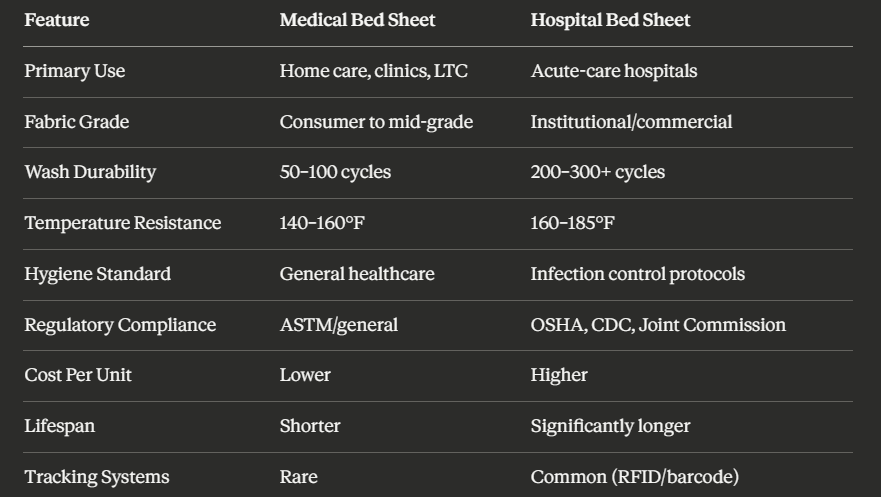
Medical Bed Sheet vs Hospital Bed Sheet: The Key Differences Side by Side
Why the Difference Matters: Real-World Scenarios in the USA
Home Health Care in the Midwest
A family in Columbus, Ohio, sets up a hospital-style bed at home for a parent recovering from hip surgery. In this situation, a high-quality medical bed sheet — soft, breathable, and easy to wash at home — is the right choice. Purchasing full hospital-grade institutional sheets would be overkill and often harder to source in smaller quantities.
Hospital Procurement in New York or Los Angeles
A large urban hospital processes thousands of sheets per week through an on-site laundry facility. Every linen decision has cost implications. Using under-spec sheets that degrade after 50 washes dramatically increases replacement costs. This is where proper hospital bed sheets, sourced from manufacturers like Minmax Textile, make a tangible difference to the facility’s operating budget and patient hygiene standards.
Long-Term Care Facilities in Texas or Florida
Nursing homes and skilled nursing facilities sit in an interesting middle ground. They need sheets durable enough for frequent laundering, but do not always have the same acute infection-control requirements as an ICU. Many facilities in states like Texas and Florida use mid-grade reusable linens that bridge the gap — more robust than typical home-care medical sheets but not the full specification of an acute-care hospital sheet.
Material and Fabric: What You Need to Know
Cotton vs Polyester Blends
Pure cotton sheets feel softer against skin and breathe better, which matters enormously for patients with sensitive skin, pressure ulcers, or those who run hot. However, 100% cotton wears out faster under the stress of industrial laundering.
Hospital sheets often use a 50/50 or 60/40 cotton-polyester blend. The polyester adds tensile strength and reduces shrinkage, extending the sheet’s usable life through hundreds of high-temperature washes. Minmax Textile offers both pure cotton and blended options across its medical and hospital linen range, giving procurement teams the flexibility to match specifications to their specific use cases.
Thread Count and GSM
Thread count is often misunderstood. In the hospital linen industry, GSM (grams per square meter) is a far more reliable indicator of fabric quality and durability. A sheet with a higher GSM — typically 130 to 180 for institutional use — holds up better across hundreds of industrial wash cycles.
Chasing a high thread count on a hospital sheet without considering GSM is a purchasing mistake that costs many US healthcare facilities money every year.
Disposable vs Reusable
The USA healthcare market has seen growing adoption of disposable bed sheets, particularly in single-use clinical settings and isolation rooms. Disposable options reduce laundry overhead but generate significant textile waste. Reusable hospital sheets, when properly spec’d and maintained, have a substantially lower lifetime environmental impact — a consideration increasingly relevant to sustainability-focused healthcare networks across the country.
Hygiene and Infection Control: The Standard That Separates Them
One of the most significant differences between medical and hospital bed sheets is the infection control standard they are designed to meet.
Hospital bed sheets must be compatible with the CDC’s Healthcare Infection Control Practices Advisory Committee (HICPAC) laundering protocols and align with standards set by the American National Standards Institute (ANSI) and the Textile Rental Services Association (TRSA).
These protocols require:
- Washing at bactericidal temperatures (minimum 160°F for a specific time period)
- Use of hospital-grade detergents and disinfectants that the fabric must withstand
- Proper segregation and handling of soiled linen to prevent cross-contamination
- Shelf life and storage standards for clean linen
Medical bed sheets used in home care settings are subject to far less stringent regulatory requirements, though responsible buyers still look for products that meet basic antimicrobial and hygiene standards.
How to Choose the Right Sheet for Your Needs
For Home Care Buyers in the USA
If you are purchasing sheets for a home health setup — whether in a city apartment in Boston or a rural home in rural Nebraska — focus on:
- Softness and skin comfort (look for high cotton content)
- Easy care at home washing temperatures
- Fitted sheet compatibility with the specific bed model
- Waterproof or fluid-resistant options if incontinence is a concern
For Healthcare Facility Procurement Teams
If you are sourcing for a clinic, nursing home, or hospital in the USA, UK, Canada, France, or Germany, prioritize:
- GSM weight appropriate to your laundering system
- Wash cycle durability rating (ask manufacturers for test data)
- Compliance with OSHA and infection control guidelines
- Supplier reliability and lead times (critical for high-volume facilities)
- Total cost of ownership, not just purchase price per unit
Minmax Textile works directly with healthcare procurement teams to provide specification sheets, sample batches, and volume pricing that support smarter buying decisions.
Sourcing Tip: What to Ask Your Linen Supplier
Whether you are searching for “hospital bed sheets near me” in Atlanta or working with an international textile supplier, these are the questions that matter:
- What is the GSM weight and cotton-polyester ratio?
- How many industrial wash cycles has this product been tested for?
- Does it meet TRSA or equivalent certification standards?
- What are the recommended laundering temperatures and detergent compatibility?
- Do you offer RFID or barcode tagging for laundry management?
- What are the minimum order quantities and lead times for US delivery?
Getting clear answers to all six questions separates a supplier worth working with from one that will cost you money down the line.
Local Insight: The US Healthcare Linen Market
The US healthcare linen services market is valued in the billions. It continues to grow, driven by an aging population, expanding long-term care infrastructure, and increased focus on infection prevention post-pandemic. States with the largest healthcare networks — California, Texas, Florida, New York, and Pennsylvania — account for the greatest demand for both medical and hospital-grade linens.
At the same time, rural healthcare facilities and home health agencies in states like Wyoming, Montana, and Vermont face unique supply chain challenges. For these buyers, finding a reliable supplier like Minmax Textile that ships nationally with consistent quality and availability is often more important than price alone.
FAQ: Medical Bed Sheet vs Hospital Bed Sheet
Q1: Is a medical bed sheet the same as a hospital bed sheet? No. Medical bed sheets are a broad term covering any bedding used in healthcare settings, including home care. Hospital bed sheets are a specific institutional grade designed for acute-care facilities, built for heavy-duty laundering, infection control, and extended durability.
Q2: Can I use hospital bed sheets at home? Yes, but it is usually unnecessary. Hospital-grade sheets are designed for industrial washing systems and may feel stiffer than home-care medical sheets. For home use, a quality medical bed sheet from a trusted supplier will provide better comfort and easier maintenance.
Q3: What material is best for hospital bed sheets in the USA? A 50/50 or 60/40 cotton-polyester blend with a GSM of 130-180 is the industry standard in most US hospitals. This combination balances comfort, durability, and laundry cost efficiency.
Q4: How often should hospital bed sheets be replaced? Institutional hospital sheets should be evaluated for replacement after 200 to 300 industrial wash cycles or when signs of fabric thinning, pilling, or loss of structural integrity appear. Regular auditing of linen condition is a best practice recommended by most US healthcare laundry programs.
Q5: Where can I buy medical or hospital bed sheets in the USA? Both are available through healthcare linen suppliers, medical supply distributors, and specialized textile manufacturers. Minmax Textile supplies both medical and hospital-grade bed sheets to healthcare facilities and procurement buyers across the USA, UK, Canada, France, and Germany, with competitive pricing and reliable lead times.
Conclusion: Know What You Are Buying
The difference between a medical bed sheet and a hospital bed sheet is not just a matter of terminology. It reflects a fundamental difference in design philosophy, material engineering, and performance expectation.
For home health buyers, the right answer is almost always a quality medical bed sheet built for comfort and easy home care. For hospital procurement teams and large facility managers, anything less than a properly spec’d institutional sheet is a false economy that will cost more in replacement cycles and compromise infection control standards.
The smartest buyers — whether they are managing a 500-bed hospital in Chicago or setting up a home care room in suburban Phoenix — take the time to understand these differences before placing an order.
Minmax Textile has been supplying healthcare-grade bed linens to facilities across the USA, UK, Canada, France, and Germany, combining quality manufacturing with practical procurement support. If you are evaluating your linen program or sourcing for a new facility, reach out to the Minmax Textile team for specifications, samples, and pricing tailored to your needs.