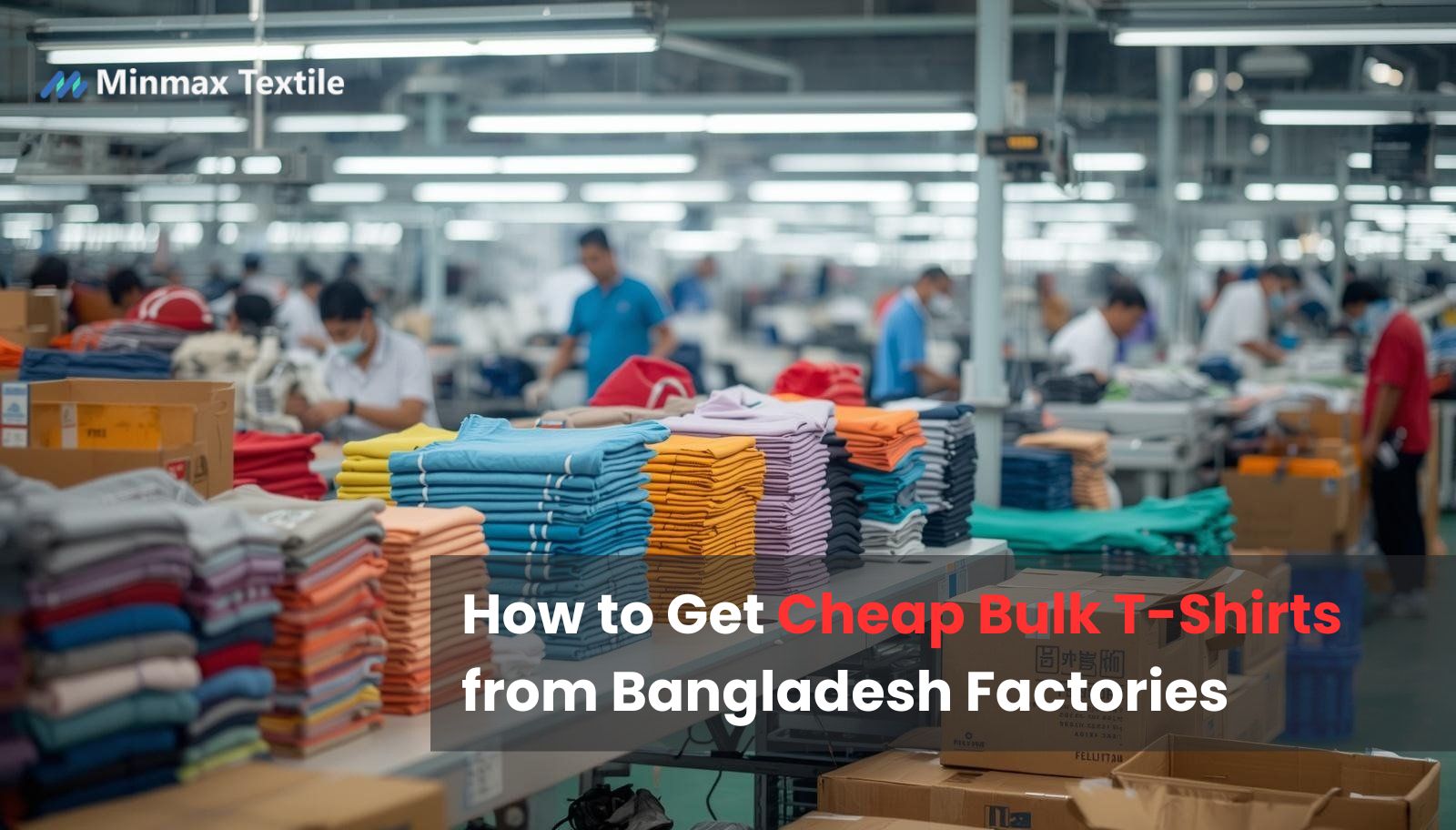
If you want to buy cheap bulk t-shirts, Bangladesh is one of the best places to start.
The country is known for large-scale garment production, skilled factory teams, and competitive pricing. Many fashion brands, wholesalers, corporate buyers, and online sellers source t-shirts from Bangladesh because they can get high-quality products at lower costs.
But low price alone should not guide your decision.
You need to know how factories price t-shirts, how fabric costs affect the final price, how printing affects the final price, and how to avoid mistakes when placing a bulk order. When you understand the full process, you can save money and still get a product that fits your brand.
This guide explains how to get cheap bulk t-shirts from Bangladesh factories smartly and safely.

Why Bangladesh Is a Strong Choice for Bulk T-Shirts
Bangladesh has built a strong position in the global apparel market. The country produces a large number of knit garments, and t-shirts are among its strongest product categories.
Factories in Bangladesh work with many kinds of buyers. Some supply big international brands. Others work with small businesses, private labels, event companies, gyms, schools, charities, and online stores.
This wide experience helps buyers in two ways.
First, factories already know how to manage bulk production.
Second, many suppliers understand custom orders, export documents, packaging rules, and shipping needs.
The biggest reason buyers choose Bangladesh is price.
Labor costs are lower than in many other garment-producing countries. The local supply chain is also strong. Yarn, knitting, dyeing, sewing, printing, embroidery, finishing, and packing often happen within the same network. This reduces production time and costs.
That is why Bangladesh is a good option if you want bulk t-shirts at a better price.
Know What “Cheap” Really Means
Many buyers make one mistake at the start.
They search for the lowest quote and think that is the best deal.
That approach often creates problems.
A cheap t-shirt is not useful if the fabric shrinks, the stitching opens, the print cracks, or the size does not match your chart. The best result comes when you find the lowest possible price for the quality level you need.
So, when you say cheap bulk t-shirts, you should think about value.
A good supplier helps you lower costs by choosing the right fabric, GSM, print method, and production plan. That saves money without hurting product quality.
This is the real goal.
Start with the Right Product Plan
Before you talk to any factory, define your t-shirt clearly.
If your request is vague, the supplier may send an unclear price. Then you will not know whether the quote is truly low or just incomplete.
You should decide the basics first.
Think about the fabric type, fabric weight, style, color, size range, logo method, quantity, and target market.
A basic round-neck t-shirt for promotion will cost much less than a fitted fashion tee with premium cotton, custom labels, neck tape, embroidery, and special packaging.
The more details you add, the higher the price may go.
So keep the product simple if you want a better bulk rate.
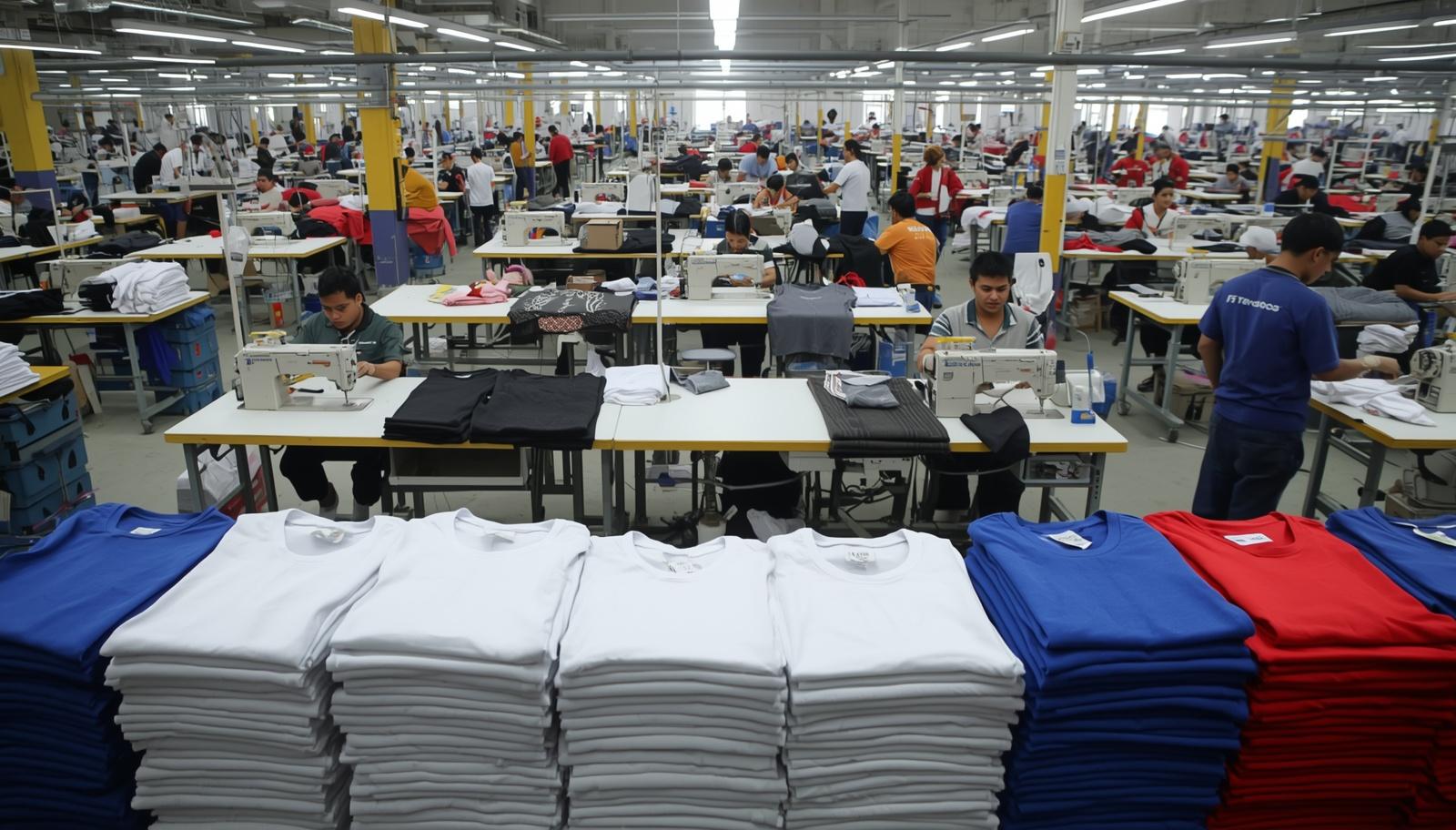
Choose Fabric Carefully to Control Cost
Fabric is one of the biggest cost factors in t-shirt production. Your choice here will shape the final price more than almost anything else.
Many factories use different yarn blends for t-shirts. Common options include 100% cotton ring-spun yarn, cotton and polyester blends, 100% polyester yarn, and, in some cases, cotton mixed with viscose and spandex for women’s styles.
If you want the lowest price, 100% cotton is not always the best choice.
Cotton feels soft and natural, but it often costs more than polyester or mixed fabric. Polyester is usually cheaper and works well for sportswear, gym wear, and event shirts. Cotton-poly blends are also popular because they give a balance of comfort, strength, and cost.
You should also pay attention to GSM.
GSM means the weight of the fabric. A lower GSM usually costs less because it uses less yarn. A lighter t-shirt may work well for summer, promotions, giveaways, and budget retail. A heavier fabric may feel more premium, but it raises the price.
If your main goal is affordable bulk production, ask the factory to suggest a fabric that fits your budget and market.
That simple step can save you a lot.
Understand How Yarn and Fabric Planning Affect Price
In garment production, factories do not guess fabric needs. They calculate fabric and yarn use very carefully. The source material you shared explains that merchandisers often estimate yarn quantity, fabric consumption, processing cost, and fabric cost per garment before final production.
This matters because your price depends on actual material use.
If your design requires more fabric, more stitching, or additional treatment, the cost will increase. If your shirt has a simple shape and uses standard fabric, the supplier can often offer a better rate.
That is why experienced buyers ask for a cost breakdown.
You do not need every technical detail, but you should understand what is driving the price.
A good factory can explain whether the higher rate is due to yarn, dyeing, printing, sewing, packaging, or order size.
This helps you decide where to cut costs.
Find the Right Bangladesh Factory
Not every factory is the right fit for every buyer.
Some factories focus on very large orders. Some work better with medium-sized buyers. Others are trading companies, not direct manufacturers.
If you want cheap bulk t-shirts from Bangladesh factories, try to deal directly with a factory whenever possible. A direct supplier often offers better prices because no intermediary is taking extra margins.
You should also check whether the factory has experience with knit garments and t-shirts. A general garment supplier may not give you the best efficiency for t-shirt orders.
When shortlisting suppliers, consider their product line, export history, communication quality, and response speed. A reliable factory usually answers clearly and asks the right questions.
That is a good sign.
Ask for Quotes from More Than One Supplier
Never stop at one quotation.
Contact several factories and send the same product details to each one. This gives you a fair comparison. It also shows you the market range.
Sometimes one supplier offers a low price but omits packing, labels, or printing. Another gives a slightly higher quote but includes more services.
You need to compare the total value, not just the first number.
When requesting a quote, include your target quantity, fabric type, GSM, t-shirt style, print or embroidery details, color count, packaging requirements, and delivery timeline.
The clearer your brief is, the more accurate the quote will be.
That makes negotiation easier.
Use Simple Designs to Keep the Price Low
Design choices affect cost quickly.
If you want cheap t-shirts, keep the product simple.
A plain t-shirt with one print position will cost less than a shirt with chest print, back print, sleeve print, embroidery, woven labels, and custom polybags.
The same rule applies to printing.
Your source notes that common t-shirt printing methods include screen printing, direct-to-garment, dye sublimation, heat press printing, and heat transfer vinyl. It also explains that different methods fit different quantities and fabrics.
For bulk orders, screen printing is often the most cost-effective option for simple artwork. It works especially well when you have large quantities and limited colors.
If you use too many colors, special effects, or full-coverage designs, the cost will go up.
So, if budget is a concern, keep the artwork clean and practical.
Think Carefully Before Adding Embroidery
Embroidery looks premium, but it usually costs more than printing.
It may still be a good choice if you are making corporate t-shirts, uniforms, branded polos, or promotional garments for business use. Your source also notes that direct embroidery and embroidery patches are common methods used in t-shirt development.
If your buyers want a polished brand look, embroidery may add value.
But if your goal is low-cost bulk supply, printing is often the better option.
Always compare both methods before you decide.
Order Samples Before Bulk Production
Never place a large order without a sample.
This is one of the easiest ways to avoid loss.
A sample helps you check the fabric’s hand feel, fit, stitching, color, print quality, and overall look. You can also test shrinkage, stretch, shape retention, and wash result if needed.
If the sample has issues, fix them before bulk production starts.
This step may take a little time, but it protects your money.
It also helps build trust between you and the factory.
Watch the Sewing and Making Quality
A t-shirt may look good in photos and still fail in production.
That is why you need to pay attention to the making process. The source text outlines common steps in t-shirt making, such as pattern and fabric cutting, joining the front and back panels, assembling sleeves, stitching hems, attaching neckbands, and label setting. It also mentions common sewing machines, such as single-needle lockstitch machines, overlock machines, and flatlock machines.
You do not need to become a technical expert.
But you should ask about stitching quality, neckline finish, label placement, measurement control, and inspection.
A factory that manages these well will reduce defects and lower risk.
That helps you save money in the long run.
Do Not Ignore Finishing and Packaging
Finishing and packing also affect cost and presentation.
The source explains that packaging is the final stage of garment manufacturing and may include bags, boxes, cartons, wrappers, and other forms, depending on buyer needs. It also notes that packaging protects the product during transportation and improves presentation.
If you want a lower cost, keep packaging simple.
Standard folding, basic polybags, and export cartons usually work well for bulk orders. Fancy boxes, inserts, stickers, and custom packaging add cost fast.
Ask yourself whether the buyer truly needs premium packaging.
If not, stay simple.
Negotiate Like a Serious Buyer
Factories respect buyers who know what they want.
So negotiate with clear numbers and realistic goals.
Do not just say, “Give me your best price.”
Instead, say what quantity you want, what budget you are targeting, and what details you are willing to adjust.
You may lower costs by changing the fabric blend, reducing the number of print colors, simplifying labels, or increasing order volume.
You can also ask for a better rate if you plan to repeat orders.
That often works better than pushing hard on the first order alone.
Build a Long-Term Supplier Relationship
The best prices often come later, not at the start.
Once a factory trusts you, understands your product, and sees potential for repeat business, it may offer better payment terms, lower pricing, and faster production support.
So think beyond one shipment.
A stable supplier relationship can lower your sourcing cost over time and make your business easier to run.
That matters a lot if you plan to scale.
Common Mistakes to Avoid
A few mistakes can turn a cheap order into an expensive problem.
Avoid these:
- Choosing the lowest quote without checking quality
- Giving unclear product details
- Skipping sample approval
- Using too many design extras
- Ignoring packaging cost
- Working without written confirmation
Simple planning prevents most of these issues.
FAQ: How to Get Cheap Bulk T-Shirts from Bangladesh Factories
Why are t-shirts from Bangladesh cheaper?
T-shirts from Bangladesh are often cheaper because labor costs are lower and the garment supply chain is well-developed. Many factories can handle knitting, dyeing, sewing, printing, and packing in a single integrated system, helping reduce costs.
What fabric is best for cheap bulk t-shirts?
Cotton-polyester blends and polyester fabrics are often better for low-cost bulk orders. They usually cost less than premium 100% cotton and still work well for many markets.
Should I buy directly from a factory or from a trading company?
Buying directly from a factory can help you get better pricing. It also gives you more control over production. But you should always verify whether the supplier is a real manufacturer.
What is the best printing method for cheap bulk t-shirts?
For many bulk orders, screen printing is one of the most affordable options, especially for simple designs with fewer colors. The best method still depends on your fabric, design, and quantity.
Can I order a sample before bulk production?
Yes, and you should. A sample helps you check quality, fit, stitching, and print before you place a large order.
Does simple packaging help lower the cost?
Yes. Basic packaging usually costs much less than custom retail packaging. If your market does not need a premium presentation, simple packing is a smart way to save money.
Is Bangladesh good for custom t-shirt orders?
Yes. Many factories in Bangladesh handle custom fabric, printing, embroidery, labels, and packaging. You should still keep the design simple if your main goal is low cost.
Conclusion
Getting cheap bulk t-shirts from Bangladesh factories is possible when you use the right method.
Start with a simple product. Choose fabric wisely. Contact several factories. Compare full quotes. Test samples. Keep printing practical. Watch the sewing quality. Keep packaging basic. Then build a long-term relationship with a supplier that fits your business.
Bangladesh offers strong value for buyers who understand the process.
If you focus on both price and quality, you can source t-shirts at a low cost and still protect your brand.