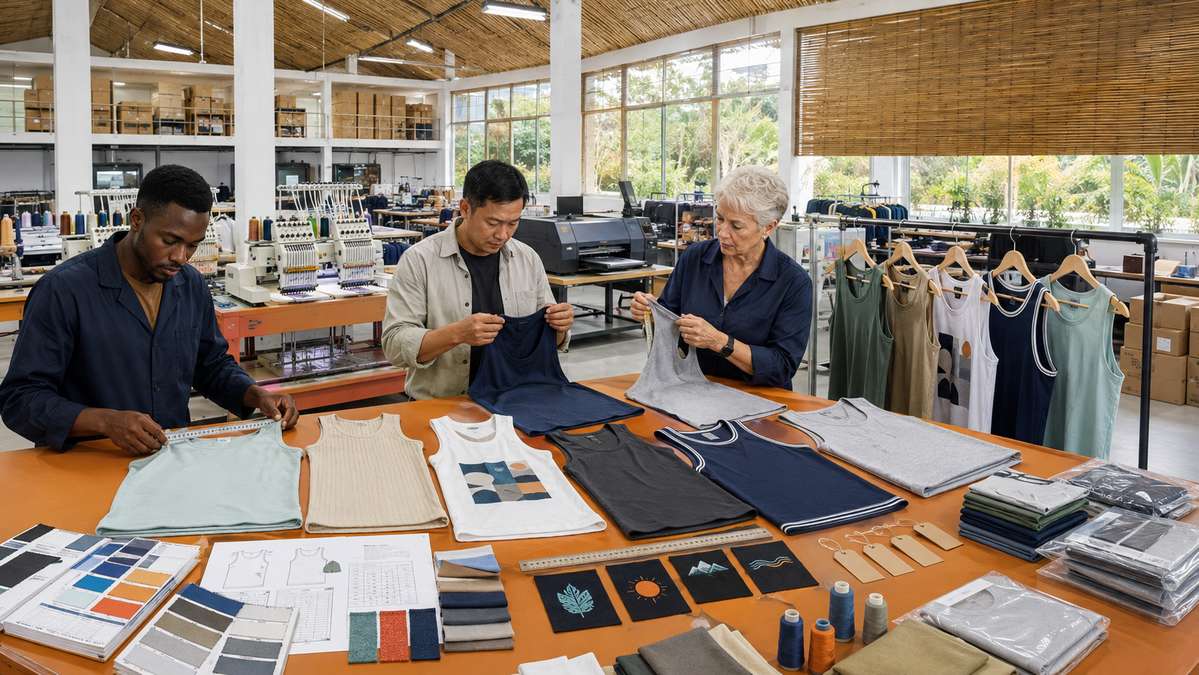
Boys’ tank top manufacturers produce sleeveless garments for fashion brands, retailers, schools, sports organizations, wholesalers, and private-label businesses. Buyers should compare manufacturers based on fabric knowledge, pattern development, size grading, neckline and armhole construction, customization capabilities, sample quality, production capacity, quality control, pricing, and delivery reliability. Detailed technical packs and approved physical samples help prevent problems with fit, shrinkage, decoration, stitching, and material consistency during bulk production.
Understanding Boys’ Tank Top Manufacturing
Boys’ tank tops are sleeveless garments designed for casual wear, sports, sleepwear, layering, summer collections, and promotional programs. Although the basic shape appears simple, successful production requires careful control of fabric, fit, neck openings, armholes, shoulder width, hems, seams, artwork, and finishing.
The garment should provide comfortable movement without creating excessively large armholes or an unstable neckline. Fabric selection and pattern grading are especially important because children’s body proportions change throughout the size range.
Buyers can review a supplier’s boys’ tank tops collection to understand the general products available for customization and bulk ordering. Displayed products should still be supported by written specifications, physical samples, and confirmed commercial terms.
Common boys’ tank top styles include:
- Basic cotton tank tops
- Ribbed tank tops
- Graphic tank tops
- Sports tank tops
- Athletic singlets
- Basketball-style tanks
- Racerback tank tops
- Muscle tank tops
- Performance tank tops
- Striped tank tops
- Color-blocked tank tops
- Pocket tank tops
- Sleepwear tanks
- Undershirts
- Toddler tank tops
- Tank top bodysuits
- Promotional tank tops
The right style depends on the wearer’s age, intended activity, season, destination market, retail price, and brand identity.
What Do Boys’ Tank Tops Manufacturers Provide?
Boys’ tank tops manufacturers may manage the complete production process from initial development through export packaging. Available services depend on the supplier’s equipment, workforce, fabric-sourcing network, decoration facilities, and order requirements.
Typical services include:
- Fabric sourcing
- Custom fabric development
- Pattern making
- Size grading
- Sample production
- Fabric spreading
- Cutting
- Sewing and assembly
- Neckline binding
- Armhole binding
- Screen printing
- Digital printing
- Heat-transfer printing
- Sublimation printing
- Embroidery
- Garment dyeing
- Garment washing
- Label production
- Quality inspection
- Folding and packaging
- Export preparation
Some suppliers customize established designs by changing colors, artwork, labels, or packaging. Others develop original garments from technical packs, measurement charts, sketches, or reference samples.
Buyers should determine whether the manufacturer specializes in knitted casualwear, athletic apparel, infant garments, or multiple categories. A factory experienced with basic cotton tanks may require different machinery and technical knowledge for stretch performance fabrics, sublimated sports tops, or infant bodysuits.
Choosing Suitable Fabrics for Boys’ Tank Tops
Fabric affects comfort, breathability, stretch, opacity, durability, shrinkage, printing performance, and production cost. Buyers should specify the required fiber composition, construction, weight, color, finish, and performance standards.
Cotton Jersey
Cotton single jersey is widely used for casual, summer, sleepwear, and graphic tank tops. It can provide softness, breathability, and a smooth surface for printing.
Buyers should state the required yarn type, fabric weight, shrinkage limits, colorfastness, and finishing. Descriptions such as lightweight or premium cotton are not precise enough for production without measurable standards.
A product such as an anime boys’ tank top can provide a visual reference for a printed cotton design. The final order should still define the fabric specification, artwork dimensions, colors, placement, sizing, and testing requirements.
Cotton and Polyester Blends
Cotton-polyester blends may combine softness with durability, shape retention, and faster drying. They can be suitable for school, casual, promotional, and activewear collections.
The exact blend percentages should be documented because different ratios can affect the garment’s surface, shrinkage, pilling, dye response, and printing compatibility. Buyers should evaluate a physical fabric swatch rather than approving the blend by name alone.
Ribbed Fabrics
Rib-knit fabrics provide stretch and are commonly used for fitted tank tops, undershirts, and layering garments. Rib structures can follow the body more closely while allowing movement.
The fabric should recover after stretching and washing. Weak recovery can cause the neckline, armholes, and body to lose their shape. The specification should identify the rib structure, fiber composition, weight, stretch direction, recovery requirements, and finished appearance.
Polyester and Performance Knits
Polyester jersey, mesh, and engineered performance fabrics may be used for sports, training, teamwear, and quick-drying tank tops.
Buyers should define requirements for:
- Moisture management
- Breathability
- Stretch
- Recovery
- Opacity
- Snag resistance
- Pilling resistance
- Colorfastness
- Print compatibility
- Drying performance
Performance claims should be supported by suitable testing when they form part of the product’s marketing or technical requirements.
Cotton-Elastane Fabrics
Adding elastane may improve stretch, fit, and recovery. This construction can work well for fitted or active tank tops.
The manufacturer should control fabric relaxation, cutting, seam tension, and measurements. Stretch fabrics can distort during production if they are pulled excessively while being spread, cut, bound, or sewn.
Organic and Recycled Materials
Brands may request organic cotton, recycled polyester, or other materials supported by recognized documentation. Buyers should identify the specific certification, chain-of-custody records, transaction documents, and labeling language required for the destination market.
A general sustainability statement does not replace the documentation needed to support a product claim.
Important Tank Top Design Specifications
A complete technical specification helps manufacturers calculate fabric consumption, production time, decoration costs, sample charges, and unit prices accurately.
Silhouette and Fit
Boys’ tank tops may have regular, slim, relaxed, oversized, athletic, or fitted silhouettes. The technical pack should define the intended shape and provide measurements for every size.
Important measurements include:
- Chest width
- Body length
- Shoulder width
- Neck width
- Front neck drop
- Back neck drop
- Armhole depth
- Armhole opening
- Bottom opening
- Binding width
- Sweep
- Side-seam length
The pattern should be graded according to the buyer’s approved size chart. Increasing every measurement by the same amount may produce poor proportions in smaller or larger sizes.
Neckline Shape and Opening
Common neckline options include:
- Crew neck
- Scoop neck
- U-neck
- V-neck
- High neck
- Bound neckline
- Self-fabric neckline
- Ribbed neckline
The neck opening should be large enough for comfortable dressing but stable enough to maintain its shape. Younger children may require additional consideration because the garment must pass easily over the head.
Buyers should specify the neckline shape, width, depth, binding material, finished binding width, seam construction, and topstitching.
Armhole Shape
Armholes influence comfort, movement, coverage, and the overall appearance of the garment. An opening that is too small may restrict movement, while one that is too deep may provide unsuitable coverage or cause the side seams to pull.
The technical pack should define the front and back armhole shapes, opening measurements, shoulder width, binding construction, and acceptable tolerances.
Athletic and muscle-style tank tops may use deeper armholes than basic casual designs. The difference should be intentional and measurable rather than left to the manufacturer’s interpretation.
Shoulder Width
Shoulder width affects garment stability and style. Narrow straps may create a lightweight athletic appearance, while wider shoulders can provide additional coverage and support.
The shoulder should be wide enough to accommodate the required binding and seam construction. Extremely narrow sections can be difficult to sew consistently, particularly in small children’s sizes.
Binding Construction
Necklines and armholes may use self-fabric binding, rib binding, elastic binding, or another finished edge. The binding should stretch during dressing and movement while returning to its intended shape.
Buyers should define:
- Binding material
- Finished width
- Cut width
- Stretch ratio
- Attachment method
- Join position
- Thread color
- Topstitching
- Seam allowance
Poor binding control can cause puckering, twisting, uneven edges, or openings that become loose after washing.
Side Seams and Seamless Options
Most tank tops use side seams, but some ribbed undershirts may use tubular fabric when suitable machinery and fabric widths are available.
Side seams should remain balanced and should not twist toward the front or back after washing. Tubular construction can reduce sewing operations, but it may limit garment shaping, size options, and print placement.
Hems
The bottom hem should remain flat, flexible, and consistent. Coverstitching is common for knitted tank tops, although the exact stitch type and hem width should be specified.
Incorrect thread tension or fabric feeding can create wavy hems, skipped stitches, or puckering. Hem quality should be evaluated before and after washing.
Printing and Decoration Options
Decoration can transform a basic tank top into a fashion, sports, licensed, or promotional product. The selected method should match the fabric composition, artwork, order quantity, performance requirements, and target cost.
Screen Printing
Screen printing is widely used for logos, text, illustrations, and graphic artwork. It can be efficient for bulk orders with clearly separated colors.
Buyers should approve:
- Artwork dimensions
- Color references
- Print position
- Ink type
- Surface finish
- Registration
- Curing
- Hand feel
- Wash performance
Artwork size and placement may need to change across the size range to maintain balanced proportions.
Digital Printing
Digital printing can support detailed artwork, gradients, and multiple colors. Its suitability depends on the fabric composition, pretreatment, equipment, and desired finish.
A decorated physical sample should be reviewed because a digital mockup cannot confirm final color, texture, opacity, placement, or wash durability.
Heat-Transfer Printing
Heat transfers can be used for logos, numbers, names, neck labels, and decorative artwork. The transfer should bond securely without cracking, peeling, lifting, or creating excessive stiffness.
Application temperature, time, pressure, fabric compatibility, and placement must be controlled throughout production.
Sublimation Printing
Sublimation is commonly used on suitable polyester fabrics for sports and all-over printed designs. It can create detailed artwork without adding a heavy surface layer.
The manufacturer should confirm fabric compatibility, color expectations, print coverage, artwork repeats, panel alignment, and potential show-through. Cut-and-sew sublimation requires accurate coordination between printing and garment assembly.
Embroidery and Appliqués
Embroidery, patches, and appliqués may create a textured or premium appearance. However, dense decorations can make lightweight fabrics stiff or uncomfortable.
The buyer should specify artwork dimensions, thread colors, backing materials, attachment methods, placement, and skin-comfort requirements. Decorative components intended for younger children should be securely attached and suitable for the relevant market.
Sizing and Fit Development
Children’s proportions change considerably between toddler, young-child, and preteen sizes. Reliable boys’ tank tops manufacturers should develop patterns using buyer-approved measurements and grading rules.
A size range may be based on:
- Age
- Height
- Chest measurement
- Body measurements
- Market-specific clothing sizes
- A combination of measurement systems
Age labels alone may not provide sufficient accuracy because children of the same age can have different heights and body proportions.
Fit testing should evaluate:
- Neck-opening comfort
- Shoulder position
- Chest room
- Armhole depth
- Underarm coverage
- Body length
- Hem balance
- Ease of dressing
- Upper-body movement
- Comfort during sitting and activity
The wearer should be able to raise the arms, bend, sit, run, and move without excessive restriction or garment distortion.
Samples should also be evaluated after washing. Fabric shrinkage can reduce chest width and body length or cause twisted seams, distorted bindings, and uneven openings.
Tank Tops for Toddlers and Infants
Toddler and infant products require additional attention to dressing, movement, closures, and component security.
A toddler boys’ tank top can provide a general style reference. Buyers should still provide exact age or height ranges, body measurements, neck-opening requirements, garment lengths, and construction details.
Tank top bodysuits or onesies may include:
- Shoulder-envelope openings
- Neck snaps
- Crotch snaps
- Extended body panels
- Reinforced closure areas
- Binding around leg openings
- Diaper allowance
Buyers considering boys’ tank top onesies should specify closure materials, snap placement, body length, rise, leg openings, seam construction, and size grading.
Small components, trims, prints, and decorations should be appropriate for the intended age group and destination market. Relevant safety, labeling, and testing requirements should be confirmed before production.
Customization for Private-Label Brands
Private-label production allows buyers to create boys’ tank tops that reflect their brand identity, customer needs, and retail position.
Customization may include:
- Original garment patterns
- Buyer-specific size charts
- Custom fabric compositions
- Exclusive colors
- Yarn-dyed stripes
- All-over prints
- Placement graphics
- Sublimated artwork
- Embroidery
- Appliqués
- Contrast bindings
- Color-blocked panels
- Racerback construction
- Custom necklines
- Side vents
- Decorative topstitching
- Woven brand labels
- Printed care labels
- Heat-transfer neck labels
- Hangtags
- Barcode stickers
- Individual polybags
- Retail-ready multipacks
- Custom carton markings
A design such as a boy band tank top may inspire a music-themed graphic product. Buyers must own or have permission to use any protected names, logos, characters, photographs, or artwork supplied for production.
Every custom detail should be approved during sampling. Artwork files, colors, dimensions, label positions, folding methods, barcode information, and packaging instructions should be documented clearly.
How to Source Boys’ Tank Tops Step by Step
1. Define the Target Customer
Identify the intended age range, activity, season, climate, destination market, retail price, and expected product lifespan.
A basic summer tank, toddler undershirt, basketball-style top, fashion graphic tank, and performance garment require different fabrics, patterns, construction methods, and testing standards.
2. Prepare a Complete Technical Pack
The technical pack should include:
- Front and back garment drawings
- Size chart
- Grading rules
- Fabric composition
- Fabric construction
- Fabric weight
- Color references
- Neckline measurements
- Armhole measurements
- Binding construction
- Stitching instructions
- Hem details
- Artwork files
- Print dimensions and placement
- Labels and hangtags
- Folding method
- Packaging requirements
Reference images may clarify the intended appearance, but they should not replace written measurements and construction instructions.
3. Review Manufacturing Experience
Ask the supplier for examples of comparable boys’ tank tops. Relevant experience should match the required fabric, size range, construction, and decoration method.
A factory producing adult cotton undershirts may not automatically have the pattern-development experience needed for toddler garments or the printing capabilities required for performance sports tanks.
The supplier should explain which processes are completed internally and which are subcontracted. Outsourced printing, embroidery, dyeing, washing, or testing may require additional scheduling and quality controls.
4. Request Fabric and Color Samples
Review physical fabric swatches for:
- Fiber composition
- Weight
- Softness
- Stretch
- Recovery
- Breathability
- Opacity
- Surface appearance
- Color
- Shrinkage
- Pilling
- Printing compatibility
Custom colors should be compared with an approved physical standard under suitable lighting. Screen colors should not be treated as final production approvals.
5. Develop the First Sample
The development sample allows the buyer to inspect the silhouette, dimensions, fabric, neckline, armholes, shoulders, seams, bindings, hems, decoration, and general appearance.
Every correction should be recorded clearly. Measurement changes should be stated numerically, while annotated photographs or diagrams can explain construction and placement issues.
6. Conduct Fit and Wear Testing
Test the sample on an appropriate wearer or dress form. Evaluate the neck opening, shoulder placement, chest room, armhole coverage, body length, hem balance, and overall comfort.
The wearer should be able to:
- Put on and remove the garment easily
- Raise both arms
- Reach forward
- Bend comfortably
- Sit without restriction
- Run or play when appropriate
- Wear the top alone or as a layer
Sports tank tops should be tested during their intended activity. Toddler garments should be checked for easy dressing and suitable coverage.
7. Test Washing Performance
Wash testing may reveal:
- Fabric shrinkage
- Color fading
- Color bleeding
- Pilling
- Seam twisting
- Binding distortion
- Wavy openings
- Hem damage
- Print cracking
- Transfer peeling
- Embroidery puckering
- Label damage
The test method should reflect the care instructions intended for the finished garment. Buyers should define acceptable results before bulk production begins.
8. Approve a Preproduction Sample
The preproduction sample should use the final fabric, colors, measurements, bindings, stitching, artwork, trims, labels, finishing, and packaging.
Bulk fabric cutting should begin only after the buyer provides written approval and confirms the acceptable measurement and artistry tolerances.
9. Confirm Commercial Terms
Before placing a bulk order, confirm:
- Minimum order quantity
- Quantity per design
- Quantity per color
- Size assortment
- Sample charges
- Unit price
- Decoration costs
- Label and packaging costs
- Testing costs
- Payment terms
- Production lead time
- Inspection arrangements
- Shipping terms
- Delivery responsibilities
Every quotation should state what is included so buyers can compare manufacturers using equivalent specifications.
Quality Control for Boys’ Tank Top Production
Quality control should begin with fabric inspection and continue through cutting, sewing, decoration, finishing, measurement, and packaging.
Fabric Inspection
Fabric should be checked for:
- Holes
- Stains
- Shade variation
- Width differences
- Knitting defects
- Bowing
- Skewing
- Contamination
- Surface damage
- Uneven stretch
Fabric rolls from different dye lots should be controlled carefully. Mixing shades within the same garment or retail order can create visible inconsistencies.
Fabric Relaxation and Shrinkage Control
Knitted fabric may require relaxation before cutting so tension created during knitting, finishing, and rolling can settle.
Patterns and cutting instructions should account for tested shrinkage. Failure to control relaxation and shrinkage may cause finished garments to become smaller or distorted after washing.
Cutting Inspection
Pattern pieces should be cut according to the approved marker, grain direction, size breakdown, and artwork requirements.
Cutting errors can affect:
- Shoulder balance
- Neckline shape
- Armhole symmetry
- Side-seam alignment
- Body length
- Finished measurements
- Print positioning
Striped, directional, or all-over printed fabrics may require additional matching and placement controls.
In-Line Sewing Inspection
In-line inspections help detect construction problems before large quantities are completed. Inspectors should review:
- Seam strength
- Stitch density
- Shoulder alignment
- Neckline shape
- Armhole symmetry
- Binding attachment
- Binding width
- Side seams
- Hem quality
- Label position
- Garment measurements
Correcting problems during sewing is generally more efficient than repairing completed garments.
Printing and Decoration Inspection
Artwork should be checked for:
- Correct design
- Dimensions
- Position
- Color
- Registration
- Coverage
- Surface quality
- Adhesion
- Curing
- Cleanliness
Printed garments should be free from smudges, stains, incomplete coverage, cracking, or artwork distortion. Embroidery should be checked for loose threads, skipped stitches, puckering, poor placement, and uncomfortable backing.
Measurement Inspection
Finished tank tops should be measured against the approved specification. Inspections should cover representative garments from every size, color, and production batch.
The buyer and manufacturer should agree on tolerances for all important measurement points before production.
Final Appearance Inspection
Finished tank tops should be checked for:
- Incorrect measurements
- Uneven shoulders
- Asymmetrical armholes
- Distorted necklines
- Wavy bindings
- Twisted side seams
- Uneven hems
- Puckering
- Broken stitches
- Loose threads
- Fabric defects
- Shade variation
- Incorrect artwork
- Print stains
- Damaged decorations
- Incorrect labels
- Poor pressing or folding
Packaging Inspection
Sizes, colors, quantities, labels, hangtags, barcodes, polybags, multipacks, carton assortments, and shipping marks should match the purchase order and approved packaging sample.
Packaging should protect garments from moisture, dirt, crushing, and excessive movement during storage and transportation.
Comparing Common Boys’ Tank Top Styles
| Tank Top Style | Typical Fabric | Main Fit Concern | Key Production Requirement |
|---|---|---|---|
| Basic cotton tank | Cotton jersey | Neck and armhole openings | Stable bindings and even hems |
| Ribbed undershirt | Cotton rib or blend | Stretch and body recovery | Controlled fabric relaxation |
| Graphic tank top | Cotton or blended jersey | Artwork scale and placement | Accurate printing and curing |
| Sports tank top | Polyester performance knit | Movement and breathability | Stretch-compatible seams |
| Racerback tank | Jersey or performance knit | Shoulder and upper-back fit | Balanced back pattern |
| Basketball-style tank | Polyester mesh or jersey | Arm mobility and body length | Durable binding and decoration |
| Toddler tank top | Soft cotton jersey | Dressing and underarm coverage | Comfortable openings and seams |
| Tank top onesie | Cotton jersey or rib | Body length and closure position | Secure snaps and reinforced openings |
Every style should have separate fabric, sizing, construction, decoration, testing, and packaging specifications.
Factors That Affect Manufacturing Cost
There is no single standard price for boys’ tank top manufacturing. The final cost depends on the complete product specification.
Important pricing factors include:
- Fiber composition
- Fabric construction
- Fabric weight
- Yarn quality
- Fabric consumption
- Custom dyeing
- Number of colors
- Order quantity
- Quantity per color
- Size range
- Pattern complexity
- Binding construction
- Neckline and armhole design
- Printing method
- Number of print colors
- Artwork size
- All-over printing
- Embroidery
- Appliqués
- Special washes
- Branded labels
- Hangtags
- Testing requirements
- Packaging
- Inspection
- Shipping terms
A basic single-color cotton tank top normally requires different materials and production time from a sublimated sports tank with custom fabric, contrast bindings, branded labels, and retail-ready packaging.
Buyers should compare quotations based on identical specifications. A lower price may exclude artwork, labels, testing, packaging, inspection, or other services included in another manufacturer’s quotation.
Questions to Ask Potential Manufacturers
Before choosing boys’ tank tops manufacturers, ask:
- Have you produced similar boys’ tank tops?
- Which knitted fabrics can you source?
- Can you develop custom fabric weights and colors?
- Can you produce cotton, ribbed, and performance styles?
- Can you develop patterns from a technical pack?
- How do you grade patterns for different age groups?
- How do you control neckline and armhole measurements?
- Which binding constructions are available?
- Which printing methods do you provide?
- Is decoration completed internally or subcontracted?
- Can you produce toddler tank tops or bodysuits?
- What is the minimum quantity per design and color?
- How are sample charges and revisions managed?
- How do you test fabric shrinkage?
- Which inspections take place during sewing?
- How is print durability evaluated?
- Can independent testing and inspection be arranged?
- Which private-label services are available?
- What are the sampling and production lead times?
- What is included in the quotation?
- How are defects, shortages, and delays handled?
Reviewing the supplier’s company profile may provide initial background information. Buyers should still verify manufacturing capabilities through physical samples, technical specifications, test reports, quotations, and direct communication.
Common Sourcing Mistakes to Avoid
Requesting Cotton Without Complete Specifications
The word cotton does not define yarn quality, fabric construction, weight, shrinkage, colorfastness, or finishing. Buyers should provide measurable requirements and approve a physical swatch.
Using Age as the Only Size Reference
Children of the same age can have different heights and body proportions. A complete garment size chart and grading rules provide more reliable production guidance.
Ignoring Armhole Coverage
Armholes that are too deep or wide may provide insufficient coverage, while small openings may restrict movement. Armhole shape and dimensions should be evaluated across the complete size range.
Overlooking Neck-Opening Comfort
A neckline may appear balanced when laid flat but be difficult to pull over the wearer’s head. Neck opening, stretch, recovery, and binding construction should be tested physically.
Approving Artwork Only on a Screen
Digital artwork cannot confirm final print color, scale, surface texture, placement, or wash durability. Buyers should approve a decorated physical sample before bulk production.
Using One Artwork Size for Every Garment
Artwork that appears balanced on a larger tank top may overwhelm a smaller size. Print dimensions and placement should be reviewed across the complete size range.
Skipping Wash Testing
Washing may reveal shrinkage, twisting, fading, pilling, print damage, wavy bindings, or distorted openings. Testing before production helps prevent larger quality problems.
Ignoring Binding Recovery
Bindings may stretch during sewing or dressing and fail to return to their intended shape. The fabric, stretch ratio, attachment method, and wash performance should be tested.
Changing Requirements After Approval
Late changes can affect fabric availability, material consumption, production cost, lead time, and product consistency. Specifications should be finalized before bulk cutting.
Comparing Unequal Quotations
Manufacturers should quote against the same fabric, construction, sizing, artwork, labels, packaging, inspection, and shipping requirements. Otherwise, the prices do not represent equivalent products.
Building a Reliable Boys’ Tank Top Supply Program
Reliable boys’ tank top manufacturers should combine fabric knowledge, accurate pattern development, children’s size grading, suitable decoration capabilities, consistent quality control, and clear communication. They should understand how fabric stretch, necklines, armholes, shoulder widths, bindings, seams, and washing affect the finished garment.
Buyers can reduce sourcing risks by preparing complete technical packs, reviewing physical fabric swatches, approving decorated samples, conducting fit and wash tests, and documenting quality standards. Production schedules, packaging instructions, payment terms, inspection requirements, and shipping responsibilities should also be confirmed in writing.
Careful preparation helps brands, schools, sports organizations, wholesalers, and retailers produce boys’ tank tops that remain consistent across sizes, colors, designs, and repeat orders. Buyers with organized specifications, quantities, artwork, fabric requirements, and delivery information can request a manufacturing quotation to begin the sampling and bulk production process.