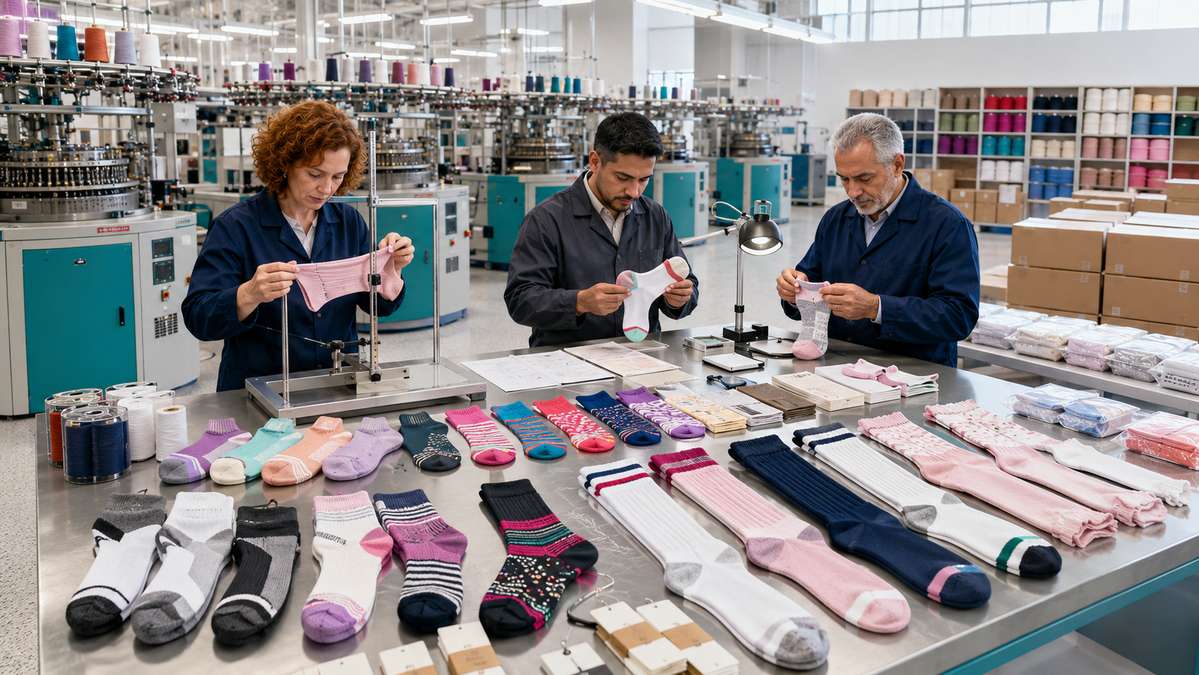
A girls’ socks manufacturer develops, knits, finishes, and packages socks for children’s fashion brands, schools, retailers, wholesalers, and private-label businesses. Buyers should compare manufacturers based on yarn expertise, knitting capabilities, size development, customization, sampling, quality control, production capacity, pricing, and delivery reliability. Approved physical samples and detailed product specifications help prevent problems with fit, stretch, colors, seams, and durability during bulk production.
Understanding Girls’ Socks Manufacturing
Girls’ socks may appear to be simple products, but their performance depends on several technical details. Yarn composition, knitting density, elasticity, heel construction, toe seams, cuffs, reinforcement, and finishing all affect comfort and durability.
Unlike cut-and-sewn garments, most socks are shaped directly on circular knitting machines. The manufacturer must select suitable machinery, needles, yarns, and knitting programs for the required size, design, and performance.
Buyers can review a supplier’s custom manufacturing services before requesting samples. A suitable manufacturer should understand children’s sizing, comfort requirements, decorative designs, private labeling, and bulk packaging.
Common girls’ sock styles include:
- Ankle socks
- No-show socks
- Quarter-length socks
- Crew socks
- Calf-length socks
- Knee-high socks
- School socks
- Dress socks
- Sports socks
- Running socks
- Hiking socks
- Thermal socks
- Grip socks
- Compression-style socks
- Patterned fashion socks
- Tights and stockings
The right product depends on the wearer’s age, footwear, activity, climate, destination market, and expected retail price.
What Does a Girls’ Socks Manufacturer Provide?
A girls’ socks manufacturer may manage the complete process from product development through export packaging. Available services depend on the manufacturer’s equipment, yarn-sourcing network, workforce, and order requirements.
Typical services include:
- Yarn sourcing
- Yarn blending
- Product development
- Size specification
- Knitting-program development
- Sample production
- Circular knitting
- Heel and toe formation
- Toe linking or seaming
- Dyeing
- Jacquard pattern knitting
- Embroidery or decorative application
- Boarding and shaping
- Washing and finishing
- Quality inspection
- Pairing
- Labeling
- Packaging
- Export preparation
Some suppliers customize existing sock patterns with new colors, logos, and packaging. Others provide original product development based on technical specifications and artwork.
Buyers reviewing the available girls’ socks collection should confirm whether displayed items are ready-stock products, production references, or customizable styles. Website images do not confirm current yarn availability, sizes, colors, minimum quantities, or pricing.
Choosing Suitable Yarns for Girls’ Socks
Yarn selection affects softness, breathability, stretch, durability, warmth, moisture control, appearance, and cost. Most socks use a combination of fibers rather than a single material.
Cotton and Cotton Blends
Cotton is widely used for everyday, school, casual, and fashion socks. It can provide softness, breathability, and moisture absorption.
Cotton is frequently blended with polyester, nylon, elastane, or spandex. Synthetic fibers may improve strength, stretch, recovery, and shape retention. Buyers should specify the required fiber percentages rather than requesting only “cotton socks.”
Polyester
Polyester can provide durability, color retention, and quick-drying performance. It is often used in sports, school, promotional, and printed socks.
The yarn quality and construction should suit the intended use. A low-quality polyester yarn may feel rough or trap excessive heat, while a suitable blend can improve durability and moisture management.
Nylon
Nylon is commonly added to strengthen high-wear areas such as the heels and toes. It can also improve abrasion resistance and help socks retain their shape.
The manufacturer should confirm where nylon will be used and whether it will be blended throughout the sock or concentrated in reinforced areas.
Elastane and Spandex
Elastane and spandex provide stretch and recovery. They help the sock remain secure around the foot, ankle, and leg.
The elastic content must be controlled carefully. Insufficient elasticity can cause socks to slide down, while excessive tension can create discomfort or leave marks on the skin.
Wool and Wool Blends
Wool blends may be suitable for thermal, outdoor, hiking, winter, and premium socks. Wool can provide warmth and moisture management, but the fiber quality and finishing affect softness.
Children’s wool socks should be evaluated for comfort because coarse fibers may cause itching or irritation. Blending wool with nylon or synthetic fibers may improve durability and shape retention.
Bamboo-Derived Viscose
Bamboo-derived viscose may provide a soft feel and smooth surface. It is often used in casual and premium sock collections.
Buyers should evaluate the actual fiber composition, durability, pilling performance, and care requirements rather than relying only on the material’s marketing name.
Common Girls’ Sock Lengths
Sock length affects appearance, footwear compatibility, comfort, and production requirements.
No-Show and Low-Cut Socks
No-show socks sit below or close to the shoe opening. Their shape must prevent slipping during movement. Silicone heel grips or specialized heel construction may be used when appropriate.
A product such as low-cut calf socks can provide an initial reference, but buyers should still specify the cuff height, heel shape, yarn composition, and intended footwear.
Ankle and Quarter-Length Socks
Ankle socks finish near the ankle, while quarter-length socks extend slightly higher. These styles are suitable for casual, school, and sports collections.
Buyers evaluating quarter crew socks should confirm the exact finished height because terms such as ankle, quarter, and low crew may be interpreted differently by different suppliers.
Crew Socks
Crew socks generally extend above the ankle and partway up the lower leg. They are widely used for school, casual, fashion, and sports products.
Examples of custom crew socks can help communicate the general product category. The technical specification should still define the cuff height, leg width, foot length, and stretch requirements.
Calf-Length and Knee-High Socks
Calf-length socks extend farther up the leg, while knee-high socks should finish near or below the knee. Both require careful cuff development so they remain in position without excessive pressure.
Manufacturing references such as calf-length socks and girls’ knee-high socks can support initial product discussions. Buyers must provide exact measurements for each size.
Important Design and Construction Specifications
A complete sock specification allows the manufacturer to select suitable yarns, machinery, needles, knitting programs, and finishing methods.
Sock Size and Foot Length
Girls’ socks may be sized by age, shoe size, foot length, or a combined size range. Buyers should identify the sizing system and destination market.
Important measurements include:
- Total foot length
- Leg length
- Cuff height
- Cuff width
- Ankle width
- Heel-to-toe length
- Toe width
- Relaxed opening
- Extended opening
Age alone may not provide enough accuracy because children of the same age can have different foot sizes.
Knit Gauge and Density
Knitting gauge influences thickness, softness, pattern detail, stretch, and durability. Finer knitting can produce a smoother surface and more detailed patterns, while heavier constructions may provide additional cushioning or warmth.
The manufacturer should confirm the machine type and needle count suitable for the design. Buyers should evaluate physical samples because numbers alone may not communicate the desired hand feel or thickness.
Heel Construction
The heel should fit securely and remain aligned during wear. Possible constructions include standard heels, Y-heels, reinforced heels, and shaped performance heels.
Poor heel development can cause twisting, slipping, bunching, or premature wear. Heel dimensions should be graded according to the approved size range.
Toe Seams
The toe may be closed using linking, hand linking, automatic linking, or another seaming method. Bulky or uneven seams can create pressure and discomfort.
Buyers should inspect the inside of the sample and test the toe seam with the intended footwear. Seam appearance alone does not confirm comfort.
Cuffs and Ribbing
Cuffs help hold socks in position. Rib structure, elastic tension, cuff width, and finishing should provide security without excessive compression.
School and knee-high socks require particular attention because weak cuffs may slide down during wear. Excessively tight cuffs may cause discomfort.
Reinforced Heels and Toes
Reinforcement can improve durability in areas exposed to repeated friction. Nylon or stronger yarns may be added to the heel and toe zones.
The reinforcement should not create noticeable stiffness or change the color and texture unexpectedly.
Cushioning
Sports, hiking, and performance socks may include cushioning under the heel, forefoot, sole, or entire foot.
Cushioning placement and thickness should be documented. Excessive cushioning can make footwear feel tight, while insufficient cushioning may fail to provide the expected comfort.
Customization for Private-Label Brands
Custom manufacturing allows brands to create socks that match their visual identity, customer needs, and retail positioning.
Customization options may include:
- Original color combinations
- Jacquard patterns
- Knitted logos
- Stripes
- Dots
- Character-inspired designs
- Seasonal artwork
- Contrast heels and toes
- Decorative cuffs
- Ruffles
- Bows
- Embroidery
- Anti-slip grips
- Cushioning zones
- Reinforced heels and toes
- Woven labels
- Printed labels
- Header cards
- Belly bands
- Barcode stickers
- Custom polybags
- Retail-ready multipacks
- Branded cartons
A manufacturer’s broader sock production range may demonstrate available product categories. Buyers should still confirm whether the factory’s machinery can reproduce the required artwork, gauge, colors, and sizes.
Complex knitted designs may have limitations based on needle count, yarn colors, and pattern resolution. Artwork should be adapted to the knitting structure rather than treated like a flat digital print.
How to Source Girls’ Socks Step by Step
1. Define the Target Customer
Identify the intended age group, shoe size range, activity, season, climate, destination market, and retail price.
Everyday school socks, decorative fashion socks, thermal winter socks, and athletic socks require different yarns, structures, and performance standards.
2. Prepare a Complete Product Specification
The specification should include:
- Sock style
- Size range
- Foot and leg measurements
- Yarn composition
- Yarn colors
- Knit gauge
- Sock thickness
- Cuff construction
- Heel construction
- Toe-closing method
- Reinforcement areas
- Cushioning zones
- Artwork
- Logo placement
- Labels
- Multipack requirements
- Packaging instructions
Reference images may explain the intended appearance, but they should not replace measurements and technical instructions.
3. Review Manufacturing Experience
Ask the manufacturer for examples of similar children’s socks. Experience with basic adult dress socks does not automatically demonstrate the ability to manufacture appropriately sized girls’ school, fashion, sports, or knee-high socks.
Product references such as girls’ high socks can help establish a general direction. Physical samples should still be evaluated before placing a bulk order.
4. Request Yarn and Color Samples
Review yarn samples for softness, thickness, color, stretch, and surface appearance. Custom colors should be compared with the approved color standard under suitable lighting.
Colors can appear different after knitting because the yarn structure, surrounding colors, and knit density affect the finished appearance.
5. Develop a Prototype Sample
The first sample allows the buyer to inspect fit, proportions, colors, pattern placement, cuff tension, heel shape, toe seams, and overall comfort.
All corrections should be recorded in writing—updated measurements and revised artwork should be provided when changes are requested.
6. Conduct Wear and Fit Testing
Test samples on wearers within the intended size range. Evaluate whether the socks:
- Remain in position
- Fit the heel correctly
- Provide enough toe room
- Avoid uncomfortable seams
- Stretch without distortion
- Recover after removal
- Work with the intended footwear
- Maintain comfort during movement
Longer socks should be checked for slipping and cuff pressure. Sports socks should be evaluated during the activity for which they were designed.
7. Test Washing Performance
Wash testing can identify shrinkage, color bleeding, fading, pilling, loss of elasticity, and shape distortion.
The agreed care method should match the instructions that will appear on the product label. Buyers should define acceptable performance standards before bulk production.
8. Approve a Preproduction Sample
The preproduction sample should use the final yarns, colors, measurements, artwork, labels, construction, and packaging.
Bulk production should begin only after the buyer documents approval and confirms any accepted tolerances.
9. Confirm Commercial Terms
Before placing the order, confirm:
- Minimum order quantity
- Quantity per design and color
- Size assortment
- Sample charges
- Unit price
- Packaging cost
- Payment terms
- Production lead time
- Inspection arrangements
- Shipping terms
- Delivery responsibilities
Every quotation should identify what is included so buyers can compare suppliers accurately.
Quality Control for Girls’ Sock Production
Quality control should take place during yarn preparation, knitting, finishing, pairing, and packaging.
Incoming Yarn Inspection
Yarns should be checked for composition, color, thickness, consistency, contamination, and visible defects. Shade differences between yarn lots should be controlled before knitting.
Knitting Inspection
During knitting, inspectors should monitor:
- Dropped stitches
- Holes
- Yarn breaks
- Uneven density
- Incorrect patterns
- Color errors
- Size inconsistency
- Heel formation
- Toe formation
- Elastic tension
Identifying knitting problems early reduces the quantity of defective products requiring repair or rejection.
Toe and Seam Inspection
Toe seams should be secure, smooth, and correctly positioned. Inspectors should check for loose threads, open seams, excessive bulk, and rough internal finishing.
Measurement Inspection
Finished socks should be measured in a relaxed state according to the approved specification. Stretch measurements may also be required for cuffs and other fitted areas.
Representative samples should be checked across all sizes, colors, and designs.
Pairing Inspection
Each pair should contain matching socks with consistent size, color, pattern placement, length, and appearance. Incorrect pairing is a common packaging defect.
Final Appearance Inspection
Finished socks should be checked for:
- Holes
- Broken yarns
- Uneven knitting
- Incorrect sizing
- Twisted heels
- Poor toe seams
- Loose threads
- Color variation
- Pattern mismatch
- Uneven cuffs
- Stains
- Incorrect labels
- Damaged packaging
Packaging Inspection
Packaging should match the purchase order and approved sample. Inspectors should verify product counts, size assortments, labels, barcodes, header cards, polybags, multipacks, carton quantities, and shipping marks.
Comparing Common Girls’ Sock Styles
| Sock Style | Typical Yarn | Main Fit Concern | Key Construction Requirement |
|---|---|---|---|
| Ankle socks | Cotton or polyester blend | Heel position and slipping | Secure cuff and shaped heel |
| Crew socks | Cotton blend | Leg fit and cuff tension | Consistent ribbing and elasticity |
| School socks | Cotton or synthetic blend | Comfort during extended wear | Reinforced heel and toe |
| Knee-high socks | Cotton, nylon, or blended yarn | Staying in position | Controlled length and cuff recovery |
| Sports socks | Polyester, nylon, or performance blend | Moisture and movement | Cushioning and durable reinforcement |
| Thermal socks | Wool or insulating synthetic blend | Warmth without excessive bulk | Dense knit and comfortable seams |
| Grip socks | Cotton or performance blend | Secure foot position | Durable anti-slip application |
| Fashion socks | Cotton, nylon, or blended yarn | Pattern and color consistency | Accurate jacquard knitting |
Each style should have separate yarn, sizing, construction, artwork, testing, and packaging specifications.
Factors That Affect Manufacturing Cost
The cost of girls’ socks depends on the complete specification rather than the product name alone.
Important pricing factors include:
- Yarn composition
- Yarn quality
- Sock weight
- Knit gauge
- Needle count
- Sock length
- Number of colors
- Pattern complexity
- Custom yarn dyeing
- Order quantity
- Quantity per design
- Size range
- Reinforced areas
- Cushioning
- Toe-linking method
- Embroidery
- Anti-slip grips
- Special finishes
- Private-label components
- Multipack configuration
- Testing
- Packaging
- Inspection
- Shipping terms
A basic single-color ankle sock normally requires different materials and production time from a knee-high jacquard sock with several colors, cushioning, a knitted logo, and custom retail packaging.
Buyers should request quotations using identical specifications. Otherwise, a lower price may reflect different yarns, weights, construction methods, packaging, or quality standards.
Questions to Ask a Potential Manufacturer
Before choosing a girls’ socks manufacturer, ask:
- Have you manufactured children’s socks in similar styles?
- Which yarn compositions can you source?
- Which knitting gauges and needle counts are available?
- Can you develop custom sizes?
- Can you reproduce knitted logos and original patterns?
- How many yarn colors can be used in one design?
- Which toe-closing methods are available?
- Can you reinforce heels and toes?
- Can you add cushioning or anti-slip grips?
- What is the minimum quantity per design, color, and size?
- How are sample charges and revisions managed?
- Which wash and performance tests are available?
- How is cuff elasticity inspected?
- Which private-label packaging options are available?
- Can an independent inspection be arranged?
- What are the sampling and production lead times?
- What is included in the unit price?
- How are defective or mismatched pairs handled?
The supplier’s company profile can provide initial background information. Buyers should still verify the manufacturer’s capabilities through samples, specifications, testing, quotations, and direct communication.
Common Sourcing Mistakes to Avoid
Requesting Cotton Socks Without a Full Composition
The term “cotton socks” does not explain the exact fiber blend. Buyers should state the required percentages of cotton, polyester, nylon, elastane, or other fibers.
Using Age as the Only Size Reference
Children of the same age may wear different shoe sizes. The specification should include foot measurements or an established shoe-size system.
Ignoring Cuff Pressure
A cuff may look correct while the sock is laid flat but feel excessively tight during wear. Cuff stretch, recovery, and comfort should be tested on appropriate wearers.
Approving Colors Only on a Screen
Screen colors can differ from yarn and finished knitted colors. Physical yarn or sock samples should be approved when color accuracy is important.
Using Artwork That Cannot Be Knitted Clearly
Highly detailed artwork may lose clarity when converted into a knitted pattern. Designs should be adjusted for the available needle count, yarn colors, and sock dimensions.
Skipping Wash Testing
Socks may shrink, fade, pill, twist, or lose elasticity after washing. Testing the approved sample helps identify these problems before bulk production.
Overlooking Internal Seams
A neat external appearance does not guarantee comfort. Buyers should inspect the inside of the sock, especially the toe seam and decorative attachments.
Comparing Unequal Quotations
Quotations should use the same yarn composition, sock weight, size range, pattern, reinforcement, labels, packaging, inspection, and shipping terms.
Building a Reliable Girls’ Socks Supply Program
A reliable girls’ socks manufacturer should demonstrate suitable knitting equipment, yarn knowledge, accurate sizing, product-development experience, consistent quality control, and clear communication. The supplier should understand how children’s socks differ from adult products in size, fit, comfort, and intended use.
Buyers can reduce sourcing risks by preparing complete specifications, reviewing physical yarns, approving knitted samples, conducting fit and wash tests, and documenting all tolerances. Packaging, labeling, inspection, production schedules, payment terms, and delivery responsibilities should also be confirmed in writing.
Careful preparation helps brands, schools, wholesalers, and retailers produce socks that remain consistent across designs, sizes, colors, and repeat orders. Buyers with organized specifications, quantities, artwork, yarn requirements, and delivery information can request a manufacturing quotation to begin the sampling and bulk production process.