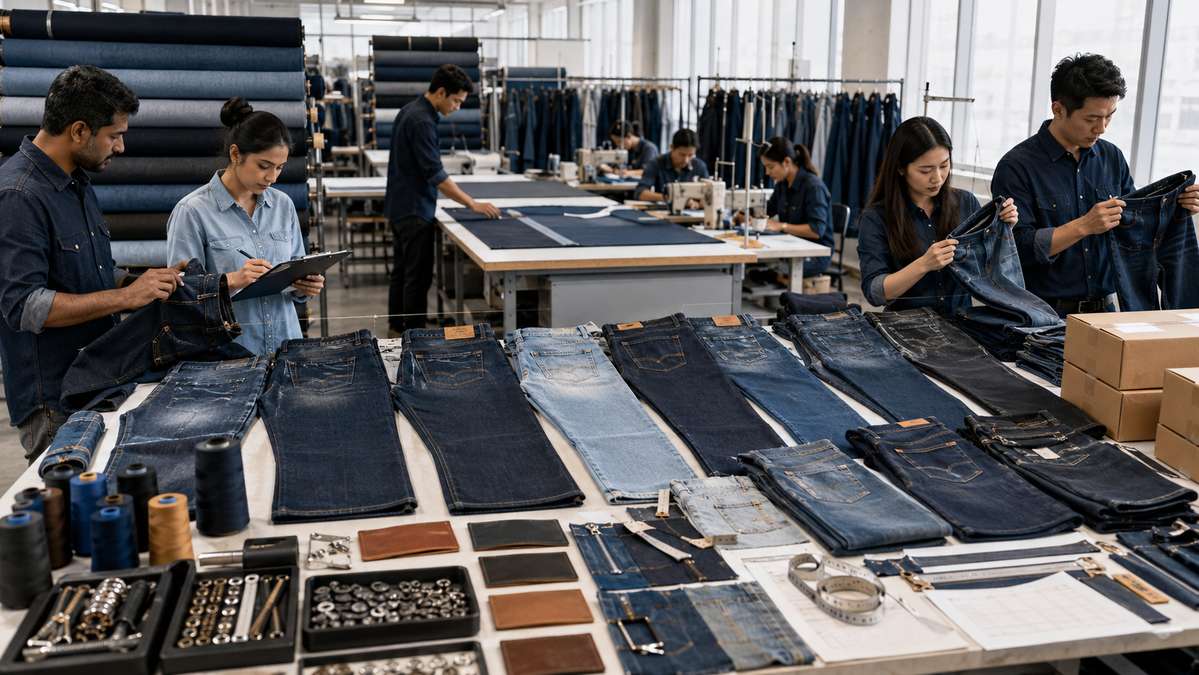
Denim jeans manufacturers produce jeans to a buyer’s specifications, managing denim fabric sourcing, cutting, stitching, hardware (rivets, buttons, zippers), washing, and finishing. Fashion brands, denim startups, retailers, and wholesalers need one whenever they want custom fits, private label branding, or bulk denim production rather than buying pre-made stock. Buyers should check fabric quality, wash consistency, fit accuracy, and MOQ before ordering.
Denim is unlike almost any other garment category, because a huge part of what makes a pair of jeans good — or bad — happens after the garment is already sewn. Wash and finishing can make or break a pair of jeans that started with perfectly good fabric and construction. That’s a detail a lot of first-time denim buyers don’t fully appreciate until they receive a bulk order with inconsistent fading, shrinkage that wasn’t accounted for, or a wash that looks nothing like the sample they approved.
This guide is written for people who are actually placing denim orders — fashion brands developing a first denim line, retailers sourcing private-label jeans, uniform suppliers needing durable workwear denim, and wholesalers comparing bulk suppliers. It covers what separates a genuinely capable denim manufacturer from one that will cost you a production run’s worth of headaches, as well as what buyers across different regions tend to prioritize.
What Denim Jeans Manufacturers Actually Do
A denim jeans manufacturer typically handles:
- Denim fabric sourcing — selecting fabric weight, stretch content, and weave from denim mills.
- Pattern cutting and construction — cutting panels for the fit specified, stitching seams, and setting in pockets
- Hardware application — attaching rivets, buttons, and zippers, which require specific machinery most basic apparel factories don’t have
- Washing and finishing — the chemical and mechanical processes that give jeans their final color, texture, and softness
- Labeling and packaging — attaching leather or faux-leather back patches, woven labels, and hang tags
Some factories only handle the cut-and-sew stage and outsource washing to a specialist laundry, while larger, vertically integrated denim clothing manufacturers manage fabric, construction, and washing all under one roof. Ask directly which model a manufacturer uses — outsourced washing adds a coordination step and potential quality variability that’s worth knowing about upfront.
Why Denim Manufacturing Is Different From Basic Apparel Production
If you’ve sourced t-shirts or shirts before, denim will surprise you in a few specific ways:
- Washing changes the garment after construction. A pair of jeans might be cut and sewn perfectly, then come out of a stone wash with uneven fading or excessive shrinkage — the fabric and the finish need to be evaluated together, not separately.
- Heavier machinery is required. Riveting and thick-seam stitching (especially at the inseam and waistband) need industrial equipment that not every general apparel factory has on hand.
- Shrinkage is more significant and less predictable. Raw or minimally processed denim can shrink noticeably during its first wash, so pattern grading has to account for this in advance.
- Colorfastness testing matters more. Dark and raw denim is prone to dye transfer if not properly treated, which becomes a real customer complaint (transferring color onto furniture or other clothing) if skipped.
None of this makes denim harder to source successfully — it just means the right questions are different from a basic cut-and-sew garment.
Denim Fabric Options Buyers Should Understand
- Cotton denim — the traditional base fabric, breathable and durable
- Stretch denim — cotton blended with elastane for added flexibility and comfort, common in slim and skinny fits
- Raw denim — unwashed, untreated denim that develops fading and character through wear over time
- Washed denim — denim that’s been through a wash process before sale, giving it a softer hand-feel and set appearance from day one
- Blended denim — cotton combined with polyester or other fibers for specific performance or cost targets
Fabric weight matters here too, typically measured in ounces per square yard. Lighter denim (under 12 oz) suits warmer climates and casual, everyday wear. In comparison, heavier denim (13 oz and above) is often chosen for workwear, durability-focused uniform jeans, or a more structured raw denim aesthetic.
Fit Options: Getting This Right Matters More Than Buyers Expect
Fit is arguably the single biggest factor in whether a denim line succeeds, and manufacturers should be able to produce and explain multiple options clearly:
- Slim fit jeans — fitted through the thigh and leg, tapering toward the ankle
- Straight fit jeans — consistent leg width from thigh to ankle, a classic, versatile cut
- Relaxed fit jeans — looser through the seat and thigh for comfort-focused wear
- Tapered fit jeans — fuller through the thigh, narrowing toward the ankle
- Regular fit jeans — a middle-ground cut between slim and relaxed, often a safe default for broad audiences
A manufacturer with real denim experience should have a fit sample or size set for each of these ready to show, rather than promising a fit they haven’t actually produced before.
Wash and Finish Options Explained
This is where denim manufacturing becomes genuinely distinct from other apparel categories. Common finishes include:
| Wash/Finish | What It Looks Like | Common Use |
|---|---|---|
| Stone wash | Softened fabric with a faded, worn appearance | Casual, everyday denim |
| Enzyme wash | Similar softening effect to stone wash, achieved with enzymes instead of stones | Eco-conscious or gentler processing preference |
| Acid wash | High-contrast, mottled fading pattern | Fashion-forward and retro-inspired denim |
| Vintage wash | Subtle fading designed to look naturally aged | Premium and heritage-style denim lines |
| Dark wash | Minimal fading, deep indigo tone | Formal-casual and workwear-adjacent styles |
| Light wash | Heavier fading for a bleached, worn look | Casual and warm-climate denim |
| Distressed finish | Deliberate rips, whiskering, or abrasion | Fashion and streetwear denim |
| Clean/raw finish | No wash treatment, deep indigo, stiff hand-feel | Raw denim positioning, develops character with wear |
Ask for a physical wash sample in your exact fabric before committing to a full run. Wash results can vary noticeably even on the same fabric depending on the machinery, chemicals, and process time a laundry uses — a photo reference alone isn’t reliable enough to base a bulk order on.
Customization Options for Denim Jeans
Beyond fabric, fit, and wash, most custom denim orders involve decisions around:
- Rivets — reinforce stress points at pocket corners, often brandable with custom engraving
- Buttons — the waistband closure, frequently custom-stamped with a brand logo
- Zippers — should be tested for durability, particularly on higher-volume production runs
- Pockets — front, back, and coin pocket styling and stitching detail
- Stitching — thread color and stitch pattern, especially on back pockets, is a common brand signature
- Labels and patches — woven waistband labels and leather or faux-leather back patches
- Embroidery or printing — used on pockets or patches for additional branding
- Packaging — folded retail packaging, tagging, and carton packing for bulk or corporate orders
Requesting a full list of customizations in writing upfront helps avoid surprise setup fees later, particularly for rivet engraving and custom-stamped buttons, which often incur separate tooling costs.
OEM, Private Label, and Wholesale Denim: Choosing the Right Model
| Model | What It Means | Best For |
|---|---|---|
| OEM jeans manufacturer | Builds jeans entirely to your custom fit, fabric, and finish specifications | Denim-focused brands with a distinct fit or wash identity and volume to justify development costs |
| Private label jeans | Uses an existing, well-developed base jean that you brand with your own patch, labels, and packaging | Brands wanting to launch a denim line quickly without full pattern development |
| Wholesale/bulk jeans supplier | Supplies denim jeans at volume, often with limited customization | Retailers, uniform buyers, and resellers prioritizing cost and speed over exclusivity |
A lot of new denim brands underestimate how much development time OEM production actually takes, given the fit sampling and wash testing involved, and instead start with private-label jeans to validate demand before investing in a fully custom fit. Manufacturers such as Minmax Textile, which typically support both private-label and OEM denim production, enable that shift without requiring a supplier switch partway through a brand’s growth.
Denim Buyer Checklist
Before committing to a manufacturer, make sure you can answer each of these:
| Checklist Item | What to Confirm | Why It Matters |
|---|---|---|
| Fabric sourcing | Denim weight, stretch content, and mill source | Determines comfort, durability, and drape |
| Wash testing | Can I see a physical wash sample in my fabric? | Wash results vary by machinery and process, not just fabric |
| Fit sampling | Is a fit sample provided before bulk production? | The only reliable way to confirm sizing accuracy |
| Shrinkage data | What’s the expected shrinkage after washing? | Prevents sizing surprises after the first customer wash |
| Colorfastness | Has the fabric been tested for dye transfer? | Protects customers from staining issues, especially with dark denim |
| MOQ | What’s the minimum order, and does it change by wash or fit? | Impacts upfront investment and testing flexibility |
| Lead time | How long from sample approval to delivery? | Affects launch timing and inventory planning |
| Hardware quality | What are the sources and durability of rivets, buttons, and zippers? | Weak hardware is a common point of product failure |
| Compliance | Does the product meet labeling requirements for my target market? | Avoids customs or retail compliance issues |
Quality Control: What to Look For Before Approving a Production Run
Denim-specific quality issues tend to cluster around a few areas:
- Stitching strength — particularly at the inseam, waistband, and pocket corners, which carry the most stress during wear.
- Fit consistency — sizing that drifts between units in the same batch, especially noticeable in slim and tapered fits.
- Fabric weight accuracy — confirm the ounce weight matches the agreed amount, since lighter fabric substitutions are a common cost-cutting shortcut.
- Colorfastness and dye transfer — dark and raw denim should be tested to confirm it won’t transfer color onto skin or other fabrics.
- Shrinkage control — jeans should be pre-shrunk or shrinkage-tested so the finished size matches the label size after a customer’s first wash.
- Finishing consistency — wash and distressing patterns should look consistent across a batch, not vary noticeably unit to unit.
Ask a prospective manufacturer directly how they test for these issues — a manufacturer with real denim experience should have a concrete answer involving lab testing or documented QC checkpoints, not a vague reassurance.
Local Insights: What Denim Buyers Prioritize by Market
United States
US denim buyers span both fashion-forward brands chasing specific washes and workwear-focused uniform buyers prioritizing durability. Stretch denim in slim and straight fits remains a strong seller across both segments.
United Kingdom
UK buyers frequently ask about sustainable denim processing, including reduced water-use washing techniques, as sustainability credentials increasingly factor into retail buying decisions.
Australia
Given the climate, lightweight denim and stretch-fabric blends tend to perform better for everyday wear. Because freight into Australia adds meaningfully to landed cost, buyers often consolidate orders to improve shipping efficiency.
UAE and Qatar
Denim demand here spans both fashion retail and a genuine market for premium, heritage-style raw denim among a fashion-conscious consumer base in Dubai, Abu Dhabi, and Doha. Buyers sourcing for retail often ask about fast turnaround for smaller, trend-responsive batches rather than only large bulk runs.
Germany
German buyers tend to prioritize fabric certification and detailed sourcing documentation, along with consistent sizing and wash quality across reorders — often weighing quality control more heavily than unit price.
Canada
Canadian buyers, like their US counterparts, often look for manufacturers that can produce smaller reorder batches without retriggering full MOQs, particularly for private-label denim lines still building sales volume.
Saudi Arabia
Growing retail and fashion sectors, tied to broader economic diversification under Vision 2030, have increased local demand for both casual and premium denim, with modest fits commonly requested for certain retail segments.
Netherlands
Dutch buyers, similar to UK and German buyers, frequently research sustainable denim processing and recycled cotton content as part of standard sourcing due diligence.
South Africa
Buyers often weigh the landed cost and lead time of imported bulk jeans against regional manufacturing partnerships, particularly for large retail or uniform program orders where consistent supply matters more than chasing the lowest unit price.
Why Location-Based Search Matters for Denim Buyers
A search for “denim jeans manufacturers near me” or “jeans factory in [city]” usually signals a buyer who’s past the research stage and ready to request samples or pricing. That makes local search visibility — an accurate, well-reviewed Google Business Profile, listings in relevant sourcing directories, and clear service area information — a genuine factor in which manufacturers get contacted first. From the buyer’s side, it’s worth verifying that a manufacturer’s actual production and washing facilities can realistically ship to your target country within your expected timeline, rather than assuming strong local search rankings guarantee efficient international fulfillment.
Trust Signals Worth Verifying
- Years of denim-specific experience — general apparel manufacturing experience doesn’t always translate to reliable denim washing and finishing capability.
- Verified reviews — check independent sourcing platforms and directories rather than relying solely on a manufacturer’s own website.
- Google Business Profile — an active, verified listing with real reviews and facility photos is a simple, useful legitimacy check.
- Fabric and wash testing documentation — ask whether shrinkage, colorfastness, and stitch strength are tested and documented, not just assumed.
- Fit samples — a manufacturer confident in their product should readily provide a physical fit sample before a bulk commitment.
- Certifications — OEKO-TEX or similar certifications relevant to denim processing and dye use.
Manufacturers like Minmax Textile that maintain visible production capacity across private-label and OEM denim, along with transparent sample and wash-testing processes, tend to support more reliable long-term partnerships than suppliers set up only for one-off bulk orders.
Common Mistakes Denim Buyers Should Avoid
- Approving a wash based on a photo — wash results vary by fabric and machinery, so always request a physical sample in your actual fabric
- Skipping fit sampling — the most common cause of costly denim production mistakes, especially with slim and tapered fits
- Ignoring shrinkage data — jeans that fit perfectly off the production line but shrink noticeably after the first wash create real customer complaints
- Underestimating hardware quality — cheap rivets, buttons, and zippers fail faster and reflect poorly on the whole garment
- Not testing for colorfastness — particularly important for dark and raw denim, where dye transfer is a real, avoidable risk
Frequently Asked Questions
What do denim jeans manufacturers actually do? Denim jeans manufacturers handle denim fabric sourcing, cutting, construction, hardware application (rivets, buttons, zippers), washing, and finishing, producing jeans either as a fully custom OEM product or as a private-label version of an existing base jean.
What’s the difference between raw denim and washed denim? Raw denim is unwashed and untreated, developing fading and character through wear over time. Washed denim has already been washed before sale, giving it a softer feel and a set appearance from the start.
What is the minimum order quantity for custom jeans? MOQs vary by manufacturer and often by wash or fit complexity, but generally range from 100–300 units for smaller custom runs up to 1,000+ units for larger wholesale jeans manufacturers.
How long does custom denim production take? Production timelines typically run 4 to 8 weeks depending on fabric sourcing, wash and finishing complexity, and order size, plus additional time for international shipping.
Why is a wash sample important before placing a bulk denim order? A wash sample confirms how a specific fabric responds to a manufacturer’s actual washing process, since results can vary noticeably even for the same fabric depending on the machinery and chemical treatments — something a photo alone can’t reliably show.
Building a Denim Line That Holds Up Past the First Wash
The manufacturers that consistently deliver good denim share a few traits: they test wash results on your actual fabric rather than promising a look from a reference photo, they provide fit samples before scaling to bulk production, and they can speak specifically about shrinkage, colorfastness, and stitch strength rather than offering vague assurances. Whether you’re developing a premium raw denim line for a fashion-forward market in Dubai, sourcing durable workwear jeans for a uniform program in Canada, or building a private-label denim collection out of the UK, those fundamentals remain the same.
Manufacturers like Minmax Textile, which supports both private-label and OEM denim production, give brands room to start with a small test run and scale into full custom development once demand is proven. If you’re ready to move forward, request a fit sample and a wash sample in your intended fabric before committing to volume — that step alone prevents most of the costly surprises denim buyers run into later.