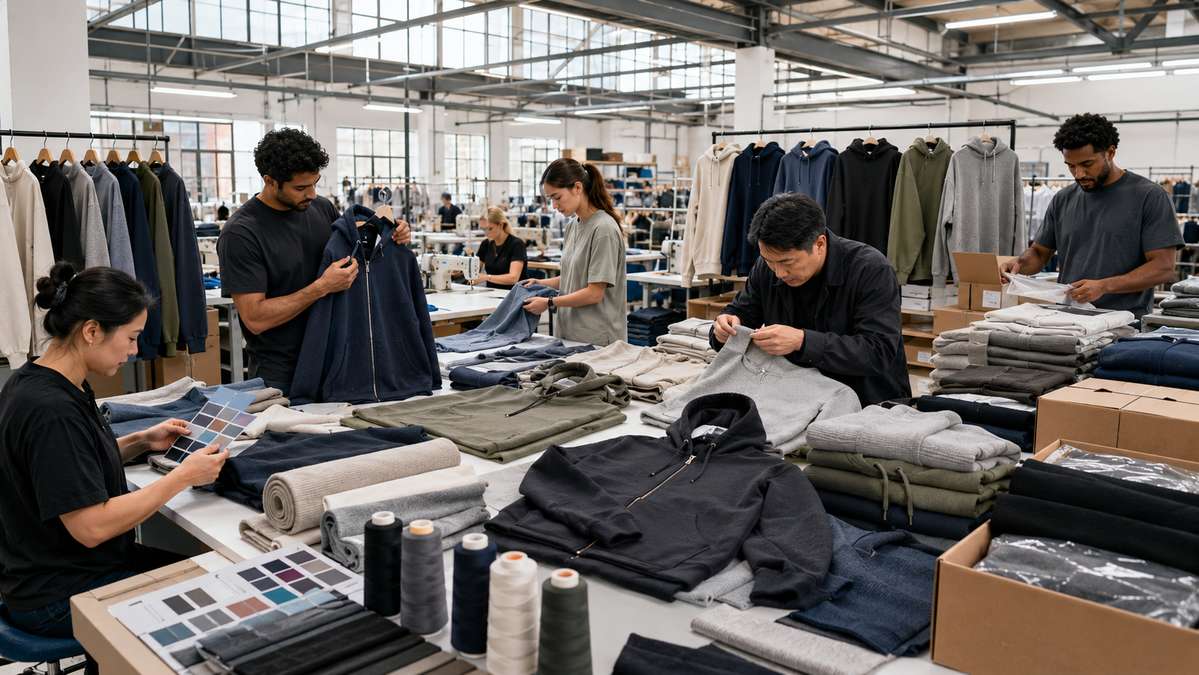
A hoodie and sweatshirt manufacturer produces fleece garments to a buyer’s specifications, covering fabric weight and brushing, hood and drawstring construction, ribbing, and print or embroidery finishing. Reliable manufacturers offer flexible order quantities, consistent fleece quality, and shipping support for markets including the USA, UK, Australia, UAE, Canada, Germany, Saudi Arabia, the Netherlands, South Africa, and Qatar.
Hoodies and sweatshirts might be the most forgiving-looking garments to manufacture — no collar, no complicated closures, just fleece and a few seams. But anyone who’s ordered a batch that arrived thin, see-through under bright light, or with a hood that flops instead of sitting right knows there’s more to it than that. Fleece weight, brushing quality, and hood construction are where cheap production cuts corners, and they’re exactly the details customers notice first when they put the garment on.
Whether you’re a streetwear brand sourcing custom hoodies, a corporate buyer ordering branded sweatshirts for a company store, or a startup testing an oversized hoodie line, this guide covers what actually separates a solid manufacturer from a risky one — along with what buyers across different regions tend to look for.
What Does a Hoodies and Sweatshirts Manufacturer Do?
A hoodies and sweatshirts manufacturer typically manages:
- Fabric sourcing — fleece fabric in various weights, brushed or unbrushed, cotton or cotton-poly blends.
- Pattern cutting — body panels, hood pieces, sleeves, and ribbing for cuffs and hem
- Construction — sewing side seams, attaching the hood, setting in the drawstring, and adding a kangaroo pocket if applicable
- Decoration — screen printing, DTG printing, embroidery, or puff print for logos and graphics
- Finishing — brushing or sanding the interior for softness, quality checks, and packaging
Some manufacturers offer only blank hoodies and sweatshirts for decorators to customize afterward. Others operate as complete custom hoodie manufacturers, managing the entire process from fleece sourcing to a finished, branded product. Knowing which one you need before requesting quotes saves a lot of back-and-forth.
OEM vs. Private Label Hoodie and Sweatshirt Manufacturing
OEM hoodie manufacturers build the garment entirely to your specifications — your fleece weight, fit, hood shape, and construction details. This route suits streetwear and fashion brands where a distinctive silhouette or fabric feel is core to the product.
Private label hoodies start from an existing, well-constructed base garment, onto which you add your own neck labels, hang tags, and packaging. It’s the faster, less expensive route and a common way to launch a hoodie line before investing in fully custom pattern development.
Why Manufacturer Choice Matters for Hoodies and Sweatshirts
A hoodie is often one of the most worn, most washed items in someone’s wardrobe, which means construction shortcuts show up fast. Key risk areas include:
- Fleece weight and opacity — thin fleece feels cheap and can go sheer in lighter colors, a common complaint with poorly made fleece hoodies
- Hood structure — a hood without proper interior lining or a well-set drawstring will flop instead of framing the face properly
- Pilling and fading — low-quality cotton-poly blends pill quickly and fade faster with repeated washing, which matters given how often hoodies get worn.
- Print and embroidery durability — cracking prints or unraveling embroidery after a few washes reflect poorly on a brand, especially for logo-heavy corporate or streetwear orders
A manufacturer that consistently gets fleece weight, hood construction, and decoration durability right is worth prioritizing over one offering a marginally cheaper quote with vague fabric specifications.
Types of Hoodies and Sweatshirts Manufacturers Typically Produce
Most manufacturers offer a fairly standard range, though quality and fleece options vary:
- Men’s Hoodies — the core product line, in pullover and zip-up styles
- Men’s Sweatshirts — typically crewneck, without a hood, for a cleaner look
- Pullover Hoodies — the classic hood-and-pocket silhouette
- Zip-Up Hoodies — full-length zipper, popular for both athletic and casual use
- Fleece Hoodies — brushed interior fleece for warmth and softness
- Cotton Hoodies — lighter weight, breathable, suited to milder climates
- Crewneck Sweatshirts — a simple, hoodless style often used for team and brand merchandise
- Oversized Hoodies — a major streetwear trend, cut with dropped shoulders and extra length
- Printed Hoodies and Embroidered Hoodies — decorated with graphics or logos depending on brand style and budget
An experienced manufacturer should have fleece swatches and sample garments ready across each of these categories, not just a single generic blank to show every buyer.
How Much Does Hoodie and Sweatshirt Manufacturing Cost?
Cost depends on fleece weight, construction complexity, decoration method, and destination. Here’s a general breakdown.
| Factor | Lower Cost Range | Higher Cost Range | Why It Varies |
|---|---|---|---|
| Fabric | Lightweight cotton-poly fleece (240-280 GSM) | Heavyweight brushed cotton fleece (400+ GSM) | Fiber content, weight, brushing quality |
| Decoration | Single-color screen print | Embroidery or puff print | Setup time, labor |
| Order size | 500+ units | Under 100 units | Setup cost distribution |
| Construction | Standard pullover hood | Zip-up with lined hood and metal hardware | Extra components and labor |
| Shipping destination | Regional | Cross-continental (e.g., to GCC or Australia) | Freight and customs duties |
Heavier fleece (above 350 GSM) generally costs more but delivers a noticeably better hand feel and durability, which matters for oversized hoodies and premium streetwear, where the fabric itself is part of the product’s appeal. If a quote looks unusually cheap, ask specifically about GSM and fiber content — that’s typically where costs get cut.
Minimum Order Quantities
- Small-batch or on-demand producers: 1–50 units
- Standard wholesale hoodie manufacturers: 100–500 units
- Large bulk hoodie suppliers: 1,000+ units
New streetwear brands or businesses testing a design should look specifically for manufacturers offering low MOQ custom hoodie production, since many suppliers now cater to smaller startup orders rather than requiring the large minimums once standard in wholesale apparel.
Private Label, OEM, or Wholesale: Choosing the Right Model
Choose private label hoodies if:
- You want your own branding without developing a garment pattern from scratch
- You’re testing hoodie demand before a bigger investment
- Speed to market matters more than a fully custom silhouette
Choose OEM manufacturing if:
- You need a specific fleece weight, oversized fit, or unique hood construction
- Your streetwear or fashion brand’s identity depends on garment details competitors don’t offer
- Your order volume justifies development and pattern costs
Choose wholesale/bulk buying if:
- You need plain or lightly branded hoodies and sweatshirts for resale, teams, or corporate stores
- You’re a winter apparel manufacturer client sourcing seasonal stock at volume
- Cost efficiency matters more than a distinctive fit
Many brands begin with private label hoodies to validate demand before moving into OEM production once volume supports custom fleece and pattern development. Manufacturers such as Minmax Textile, which typically support both private-label and OEM models, make the transition smoother, since buyers don’t need to switch suppliers as their hoodie program scales.
Step-by-Step: How to Choose a Hoodie and Sweatshirt Manufacturer
Step 1: Define Fleece Weight and Fit Before Requesting Quotes
Decide on:
- Fleece weight and brushing (lightweight vs. heavyweight, brushed vs. unbrushed)
- Fit (regular, oversized, or fitted)
- Style (pullover hood, zip-up, or crewneck sweatshirt)
- Decoration method and target quantity
Step 2: Request Physical Samples, Not Just Photos
Fleece weight, brushing softness, and hood structure don’t come through in a photo. A confident manufacturer should be willing to send a sample, even for a small fee.
Step 3: Ask Specifically About Hood and Drawstring Construction
This is a detail that separates well-made hoodies from mediocre ones:
- Is the hood lined, and how is the drawstring channel constructed?
- What material are the drawstring cord and eyelets made from?
- Is the kangaroo pocket reinforced at the stress points?
Step 4: Confirm Lead Times and Reorder Consistency
Hoodies and sweatshirts often see repeat orders, especially for corporate or team programs. Confirm the manufacturer can match fleece weight and color consistently on reorders months later.
Step 5: Check Compliance for Your Target Market
- USA: Confirm CPSC and standard care labeling compliance, particularly around drawstring safety standards for youth sizing if relevant
- UK/EU: Confirm fiber content labeling meets UK/EU textile regulations
- Australia: Confirm alignment with Australian Consumer Law product safety standards
- UAE/Saudi Arabia/Qatar: Confirm familiarity with GCC customs documentation, especially relevant given hoodies are a seasonal, time-sensitive import in these markets
- Canada: Confirm bilingual (English/French) labeling under the Textile Labeling Act
- South Africa: Confirm compliance with NRCS textile requirements
Step 6: Review Payment Terms and Documentation
Standard terms typically involve a deposit plus balance on completion. Be cautious of manufacturers who request full payment upfront without a sample or a written agreement.
Local Insights: What Buyers in Different Markets Prioritize
United States
US streetwear and DTC brands drive strong demand for oversized hoodies and heavyweight fleece, with buyers often prioritizing fabric weight and a premium hand feel to justify higher retail prices. Corporate and collegiate crewneck sweatshirt orders also remain a steady, high-volume category.
United Kingdom
UK buyers frequently ask about organic cotton fleece and sustainability credentials, and post-Brexit customs documentation should be confirmed with any overseas manufacturer before committing to a bulk order.
Australia
Given Australia’s seasonal calendar, timing production to align with the local autumn and winter months (roughly April through September) matters for retailers. Cotton-poly blends in moderate weights tend to suit the milder Australian winter better than the heaviest fleece options.
UAE and Qatar
Despite the warm climate, hoodies remain popular for air-conditioned malls, offices, and evening wear, plus travel to cooler destinations. Lighter fleece weights and cotton hoodies tend to perform better here than heavyweight, insulated styles, and demand often spikes around cooler winter months and gifting seasons.
Germany
German buyers tend to prioritize certifications such as OEKO-TEX and detailed fabric composition documentation, as well as consistent sizing and fleece quality across production batches — often placing greater weight on quality control than on price.
Canada
Canadian buyers, dealing with genuinely cold winters, often favor heavier fleece weights and fully lined hoods for warmth, as well as bilingual labeling requirements for national retail distribution.
Saudi Arabia
Similar to the UAE and Qatar, demand is driven by air-conditioned environments and cooler winter evenings rather than harsh cold, with lighter fleece and cotton hoodies generally preferred, alongside strong demand from a large youth population engaged with streetwear trends.
Netherlands
Dutch buyers, like their German and UK counterparts, frequently ask about recycled cotton or sustainable fleece options as a standard part of sourcing conversations rather than a specialty request.
South Africa
Buyers often weigh the cost of imported bulk hoodies against regional manufacturing options, particularly during South Africa’s winter season (June through August), when demand for hoodies and sweatshirts typically peaks.
Fabric and Construction Guide
- Brushed fleece — the interior is brushed for a soft, napped texture, standard for warmth-focused hoodies
- Loopback fleece — a looped interior texture, often used for lighter, more breathable sweatshirts
- Cotton-poly blends — more shrink- and pill-resistant than 100% cotton, common in mid-range and corporate hoodie orders
- 100% cotton fleece — softer hand-feel, often preferred for premium streetwear, though slightly more prone to shrinkage
- Lined hoods — hoods with an interior lining generally hold their shape better than single-layer hoods.
- Ribbed cuffs and hem — elastic ribbing at the cuffs and hem helps the garment retain its shape over repeated wear and washing.
GSM (fabric weight) is a useful shorthand here — lighter fleece (240–280gsm) suits warmer climates like the UAE, Qatar, and Saudi Arabia. In comparison, heavier fleece (350 gsm and above) suits colder markets like Canada and the northern US and is often associated with a more premium feel in oversized streetwear styles.
Building Trust When Sourcing a Manufacturer
Because so much sourcing now happens remotely, trust signals matter more than ever:
- Years in operation — manufacturers with a longer production history have generally already resolved common early-stage quality issues.
- Verified third-party reviews — check independent sourcing platforms and directories, not just testimonials on the manufacturer’s own website.
- Google Business Profile — an active, verified profile with real reviews and facility photos is a simple, useful legitimacy signal.
- Relevant certifications — OEKO-TEX, GOTS, or ISO certifications depending on your target market’s expectations
- Willingness to discuss fleece specifications — a manufacturer that can speak specifically about GSM, brushing quality, and hood construction typically has more genuine production experience than one giving vague, generic answers.
Manufacturers like Minmax Textile that maintain visible production capacity across both private label and OEM hoodie manufacturing, along with transparent sample processes, tend to support longer-term partnerships better than suppliers set up only for one-off bulk orders.
Common Mistakes to Avoid
- Choosing based on price alone — often means thinner fleece or poorly constructed hoods that show up in returns
- Skipping the sample stage — a photo can’t show you fleece weight, brushing softness, or hood structure
- Underestimating decoration durability testing — ask about wash testing for prints and embroidery, especially for logo-heavy corporate orders
- Ignoring seasonal shipping timing — particularly relevant for Southern Hemisphere markets like Australia and South Africa, where the cold season falls opposite the Northern Hemisphere calendar
- Overlooking compliance requirements — incorrect labeling or drawstring safety non-compliance can create issues in the USA, UK, EU, and Canada
Frequently Asked Questions
What GSM is best for a custom hoodie? Lighter fleece (240–280 GSM) suits warmer climates and lighter-weight hoodies, while heavier fleece (350 GSM and above) suits colder climates and premium, oversized styles. The right weight depends on your target market’s climate and your brand’s positioning.
What’s the difference between OEM and private label hoodie manufacturing? OEM manufacturing builds a hoodie entirely to your specifications, including fleece weight, fit, and hood construction. Private label uses an existing, well-made base garment that you brand with your own tags and packaging, making launch faster and less costly.
What is the minimum order quantity for custom hoodies? MOQs vary by manufacturer, typically ranging from 1–50 units for small-batch producers to 500–1,000+ units for larger wholesale hoodie manufacturers. Many manufacturers now offer low MOQ programs to accommodate startups and small businesses.
How long does it take to manufacture custom hoodies and sweatshirts? Production timelines typically range from 3 to 6 weeks depending on fleece sourcing, order size, and decoration method, plus additional time for international shipping.
Do hoodie manufacturers offer private label services? Many established manufacturers offer private label services, allowing buyers to add their own branding and packaging to an existing, well-constructed base garment without developing a fully custom hoodie from scratch.
Sourcing Hoodies and Sweatshirts That Actually Hold Up
The difference between a hoodie people wear for years and one that pills, fades, or loses its shape after a season usually comes down to decisions made long before the first unit ships — fleece weight, hood construction, and decoration durability. Whether you’re launching an oversized streetwear line in the US, sourcing branded crewneck sweatshirts for a corporate store in Germany, or timing a bulk hoodie order around South Africa’s winter season, the fundamentals hold steady: define your fleece specifications clearly, request real samples, and confirm compliance for your target market before committing to a production run.
Manufacturers like Minmax Textile, which offers both private-label and OEM hoodie and sweatshirt production, give growing brands the flexibility to scale without switching suppliers as their product line expands. If you’re ready to move forward, start by requesting a fleece sample and a written quote — that one step will tell you more about a manufacturer’s real quality standards than any pitch deck.