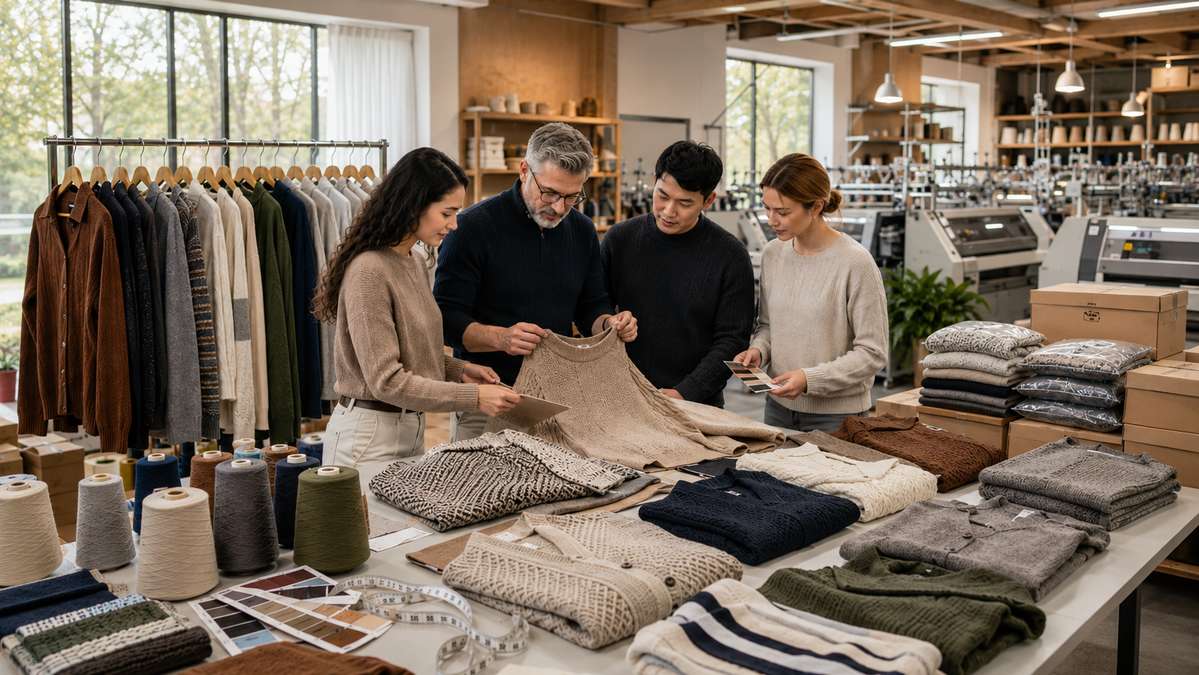
A sweater manufacturer produces knitted garments to a buyer’s specifications, covering yarn selection (wool, cotton, acrylic, or blends), knit gauge, garment construction, and finishing. Reliable manufacturers offer flexible order quantities, consistent yarn quality, and shipping to markets such as the USA, the UK, Australia, the UAE, Canada, Germany, Saudi Arabia, the Netherlands, South Africa, and Qatar.
Sweaters are a different animal from cut-and-sew garments like t-shirts or polos. Instead of cutting fabric from a bolt, a knitwear manufacturer is often building the fabric itself, stitch by stitch, on a knitting machine — which means gauge, yarn quality, and knit structure matter just as much as the final garment’s silhouette. Get the yarn wrong, and a sweater pills within a season. Get the gauge wrong, and it loses its shape after one wash.
If you’re sourcing custom sweaters for a fashion label, private label knitwear for a retail brand, or bulk pullovers for a corporate winter uniform program, this guide covers what actually separates a capable sweater manufacturer from one that will cause you headaches down the line — along with region-specific considerations for buyers across ten major markets.
What Does a Sweater Manufacturer Actually Do?
A sweater manufacturer typically handles:
- Yarn sourcing — wool, cotton, acrylic, cashmere, or blended yarns
- Knitting — producing the fabric panels on flat-knit or circular knitting machines, either fully fashioned (shaped during knitting) or cut-and-sew
- Linking and assembly — joining shoulder seams, sleeves, and side panels
- Finishing — steaming, blocking, and quality checking for shape and gauge consistency
- Decoration — intarsia or jacquard knit patterns, embroidery, or woven label attachment
- Packaging — folding, tagging, and private label branding where applicable
Some manufacturers specialize in a single knitting method or yarn category, while full-service custom sweater manufacturers can manage the entire process from yarn selection to a finished, branded garment. Understanding this distinction before requesting quotes helps you approach the right type of supplier from the start.
OEM vs. Private Label Sweater Manufacturing
OEM sweater manufacturers build a garment entirely to your specifications — your yarn blend, gauge, silhouette, and knit pattern. This is the right path for brands where a distinctive knit structure or yarn composition is central to the product.
Private-label sweaters start with an existing, well-made base garment that you brand with your own labels and packaging. It’s a faster, lower-cost route that works well for retail brands looking to add knitwear to their broader collections without having to develop a garment from scratch.
Why the Right Manufacturer Matters More for Knitwear
Knitwear carries more technical risk than woven garments, and the consequences of a poor manufacturing choice show up quickly:
- Pilling — low-quality or loosely spun yarn pills fast, which is one of the most common customer complaints with cheaply made knitted sweaters.
- Shrinkage and shape loss — incorrect washing or blocking during finishing can leave a sweater permanently out of shape.
- Gauge inconsistency — batches knitted at slightly different tensions can result in sizing that varies between units, a frustrating issue for bulk or reorder situations.
- Yarn composition mismatches — a sweater marketed as wool must actually contain the wool percentage stated on the label, for both customer trust and legal compliance.
A manufacturer that controls these variables consistently is worth more than one offering a marginally lower price with unclear yarn sourcing.
Types of Sweaters Manufacturers Typically Produce
Most manufacturers cover a fairly standard range of styles, though yarn and gauge capability varies by factory:
- Men’s Sweaters — the core category across most catalogs, in various weights and gauges
- Wool Sweaters — natural fiber, warm, and breathable, often positioned as a premium product
- Cotton Sweaters — lighter weight, suited to milder climates and transitional seasons
- Pullover Sweaters — the classic no-closure knit style
- Crew Neck Sweaters — a simple, versatile neckline used across both casual and corporate knitwear
- V-Neck Sweaters — common for layering over shirts, popular in corporate and smart-casual wardrobes
- Cardigan Sweaters — front-opening knitwear, typically with buttons or a zip
A manufacturer with genuine knitwear experience should be able to show yarn samples and gauge swatches across these categories rather than treating each specification as a new experiment.
How Much Does Sweater Manufacturing Cost?
Cost depends heavily on yarn composition, knit complexity, order size, and destination. Here’s a general framework.
| Factor | Lower Cost Range | Higher Cost Range | Why It Varies |
|---|---|---|---|
| Yarn | Acrylic or acrylic-blend | 100% merino wool or cashmere blend | Fiber cost and processing |
| Knit complexity | Plain knit, single color | Cable knit, intarsia, or jacquard patterns | Machine time, programming |
| Order size | 500+ units | Under 100 units | Setup cost distribution |
| Construction | Cut-and-sew knit panels | Fully fashioned (shaped during knitting) | Labor and machine precision |
| Shipping destination | Regional | Cross-continental (e.g., to GCC or Australia) | Freight and duties |
Wool and wool-blend sweaters generally cost more than acrylic or cotton alternatives due to raw fiber pricing, but they also tend to perform better over the life of the garment — a relevant factor for brands positioning themselves in the mid-to-premium range rather than fast fashion.
Minimum Order Quantities
- Small-batch or sample-run producers: 1–50 units
- Standard wholesale sweater manufacturers: 100–500 units
- Large bulk sweater suppliers: 1,000+ units
Because knitwear development (gauge testing, yarn sourcing, and sampling) tends to take longer than cut-and-sew garments, buyers should expect slightly longer lead times even at lower MOQs. They should look specifically for manufacturers experienced in low MOQ knitwear production rather than those set up only for large wholesale runs.
Private Label, OEM, or Wholesale: Choosing the Right Approach
Choose private label sweaters if:
- You want to add knitwear to an existing collection without developing a garment from scratch
- Speed to market matters more than a fully custom knit structure
- You’re testing demand for sweaters before a bigger investment in development
Choose OEM manufacturing if:
- You need a specific yarn blend, gauge, or knit pattern unique to your brand.
- Knitwear is a core part of your brand’s identity, not a seasonal add-on.
- Your order volume justifies development time and yarn minimums.
Choose wholesale/bulk buying if:
- You need plain or lightly branded sweaters for resale or corporate winter uniforms
- You’re a winter apparel manufacturer client sourcing seasonal stock at scale
- Cost efficiency matters more than a unique knit structure
Many retail and fashion brands begin with private label sweaters to gauge demand, then move to OEM once volumes support custom yarn and knit development. Manufacturers such as Minmax Textile, which typically support both private-label and OEM production, make this transition more manageable because buyers don’t need to onboard a new supplier as their knitwear program grows.
Step-by-Step: How to Choose a Sweater Manufacturer
Step 1: Define Yarn, Gauge, and Silhouette Before Requesting Quotes
Decide on:
- Yarn composition (wool, cotton, acrylic, or blend) and percentage
- Gauge (fine, medium, or chunky knit)
- Silhouette (crew neck, V-neck, cardigan, pullover)
- Target quantity and expected seasonal reorder pattern
Step 2: Request Yarn Swatches and Sample Garments
Yarn feel, weight, and pilling resistance are impossible to judge from a photo. A confident manufacturer should provide yarn swatches and, ideally, a knitted sample before you commit to a production run.
Step 3: Ask Specifically About Gauge Consistency and Finishing
Knitwear-specific questions matter here more than with cut-and-sew garments:
- How is gauge consistency maintained across a full production batch?
- Is the garment fully fashioned or cut-and-sew?
- What blocking and steaming process is used during finishing?
Step 4: Confirm Lead Times for Seasonal Delivery
Sweaters are seasonal by nature, so timing matters. Confirm the manufacturer can deliver ahead of your selling season — factoring in yarn sourcing, knitting, finishing, and shipping — rather than working backward from a tight deadline after the order is placed.
Step 5: Check Compliance and Labeling for Your Target Market
- USA: Confirm wool content labeling complies with the Wool Products Labeling Act and standard care labeling requirements
- UK/EU: Confirm fiber content disclosure meets UK/EU textile labeling regulations
- Australia: Confirm compliance with Australian Consumer Law product safety and labeling expectations
- UAE/Saudi Arabia/Qatar: Confirm familiarity with GCC customs documentation, particularly relevant given that winter apparel is a seasonal, time-sensitive import category in these markets
- Canada: Confirm bilingual (English/French) labeling under the Textile Labeling Act
- South Africa: Confirm compliance with NRCS textile requirements
Step 6: Review Payment Terms and Contracts
Standard terms typically involve a deposit with balance due on completion. Be cautious of manufacturers who request full payment upfront without a sample or a written agreement, especially given the longer development cycles typical of knitwear.
Local Insights: What Sweater Buyers Prioritize by Market
United States
US buyers span both fast-fashion volume orders and premium wool knitwear for department store and DTC brands. Crew neck and V-neck styles remain steady sellers, with cotton sweaters popular for warmer regions and wool blends favored in colder states.
United Kingdom
UK buyers frequently ask about wool sourcing and sustainability credentials, including British wool or recycled fiber options, reflecting strong consumer interest in provenance. Cardigan sweaters have particularly steady demand across both fashion and workwear-adjacent categories.
Australia
Given Australia’s seasonal inversion relative to the northern hemisphere, timing production and shipping to align with the local winter (June through August) is a genuine sourcing consideration, and merino wool — given Australia’s own wool industry — is a fabric buyers know and expect to be of quality.
UAE and Qatar
Sweater demand here is smaller in volume but real, driven by air-conditioned offices, malls, and cooler winter evenings, plus a market of residents and travelers seeking lighter knitwear for trips abroad. Lightweight cotton or fine-gauge wool blends tend to suit this market better than heavy, chunky knits.
Germany
German buyers often prioritize yarn certification (such as OEKO-TEX), detailed fiber composition documentation, and consistent sizing and gauge across production runs. Quality control tends to outweigh aggressive pricing as a deciding factor.
Canada
Canadian buyers, dealing with genuinely cold winters across much of the country, tend to favor wool and wool-blend sweaters for durability and warmth, alongside bilingual labeling requirements for national retail distribution.
Saudi Arabia
Sweater demand is concentrated in cooler winter months and in air-conditioned retail and office environments, with lightweight knitwear and cardigans often preferred over heavier wool pieces suited to more extreme cold climates.
Netherlands
Dutch buyers, like their German and UK counterparts, frequently ask about sustainable and recycled yarn options as a standard part of sourcing discussions rather than as a specialty request.
South Africa
Buyers often weigh the cost of imported bulk sweaters against regional manufacturing, particularly given South Africa’s seasonal winter demand (June through August) and a retail market that spans both budget acrylic knitwear and premium wool offerings.
Yarn and Construction Guide
- Wool — warm, breathable, and naturally odor-resistant; merino wool, in particular, is prized for softness and fine-gauge knitting.
- Cotton — lighter weight, breathable, suited to transitional seasons and warmer climates.
- Acrylic — affordable and easy to care for, though generally less breathable and more prone to pilling than natural fibers.
- Cashmere and cashmere blends — premium, soft-hand yarn often used in higher-end custom sweaters.
- Fully fashioned knitting — panels shaped directly on the knitting machine, generally producing a better drape and fit than cut-and-sew construction.
- Cut-and-sew knitwear — knit fabric is cut and sewn like woven fabric, typically faster and less costly, but with slightly less refined fit.
Gauge (stitches per inch) also affects both look and cost — fine-gauge knits suit dressier, lighter sweaters. In contrast, chunky-gauge knits are bulkier and generally associated with casual, heavyweight winter styles.
Building Trust When Sourcing a Sweater Manufacturer
Because knitwear sourcing often happens remotely and involves a longer development cycle than basic garments, trust signals carry real weight:
- Years of knitwear-specific experience — general apparel manufacturing experience doesn’t always translate to reliable knitwear production, so ask specifically about sweater and knitwear history
- Verified third-party reviews — check independent sourcing platforms and directories rather than relying only on a manufacturer’s own website testimonials
- Google Business Profile — an active, verified listing with real reviews and facility or product photos is a simple, useful signal of legitimacy
- Relevant certifications — OEKO-TEX, Woolmark (for wool products), or ISO certifications depending on your target market
- Willingness to discuss yarn sourcing and gauge testing — a manufacturer that speaks specifically about fiber sourcing, gauge consistency, and finishing processes typically has genuine knitwear expertise.
Manufacturers like Minmax Textile that maintain visible production capacity across both private-label and OEM knitwear, along with transparent sampling processes, tend to support long-term seasonal partnerships better than suppliers set up only for one-off orders.
Common Mistakes to Avoid
- Choosing yarn based on price alone — cheap acrylic yarn pills quickly and can undercut brand perception, even if the sweater looks fine at first
- Skipping yarn swatches and knitted samples — photos cannot convey hand-feel, gauge, or pilling resistance
- Underestimating knitwear development timelines — yarn sourcing and gauge testing generally take longer than cut-and-sew garment development
- Ignoring seasonal shipping timing — especially relevant for Southern Hemisphere markets like Australia and South Africa, where winter falls opposite the Northern Hemisphere calendar
- Overlooking wool content labeling requirements — particularly important in the USA, UK, and EU, where inaccurate fiber content claims can create compliance issues
Frequently Asked Questions
What’s the difference between fully fashioned and cut-and-sew sweaters? Fully fashioned sweaters are knitted and shaped directly on the machine, generally producing a better fit and drape. Cut-and-sew sweaters are knitted as flat fabric panels, then cut and sewn together, a process that is typically faster and less expensive but slightly less refined.
What is the minimum order quantity for custom sweaters? MOQs vary by manufacturer, typically ranging from 1–50 units for small-batch producers to 500–1,000+ units for larger wholesale sweater manufacturers. Knitwear development time is usually longer than for basic cut-and-sew garments, even at lower MOQs.
Is wool or cotton better for a custom sweater? Wool offers better warmth, breathability, and natural odor resistance, making it well suited to colder climates and premium positioning. Cotton is lighter and better suited to transitional seasons or warmer climates, though it generally provides less insulation.
How long does sweater manufacturing typically take? Knitwear production usually takes 4 to 8 weeks depending on yarn sourcing, knit complexity, and order size, plus additional time for international shipping — longer than typical cut-and-sew garment timelines.
Do sweater manufacturers offer private label services? Many established manufacturers offer private label sweater services, allowing buyers to add their own branding and packaging to an existing, well-made base garment without developing a fully custom knit from scratch.
Getting Your Knitwear Program Off the Ground
Sourcing sweaters successfully comes down to respecting what makes knitwear different from other garment categories — yarn quality, gauge consistency, and finishing all directly affect how a sweater performs after the first wash, not just how it looks on day one. Whether you’re building a wool knitwear line for a cold Canadian winter, sourcing lightweight cardigans for cooler evenings in Doha, or timing a merino wool order for Australia’s seasonal calendar, the fundamentals stay the same: define your yarn and gauge specifications clearly, request real swatches and samples, and plan lead times around your actual selling season rather than working backward under pressure.
Manufacturers like Minmax Textile, which supports both private-label and OEM knitwear production, give growing brands the flexibility to scale a sweater program without switching suppliers as demand and complexity increase. If you’re ready to move forward, start by requesting yarn swatches and a written quote — that step alone will tell you more about a manufacturer’s real capability than any sales pitch.