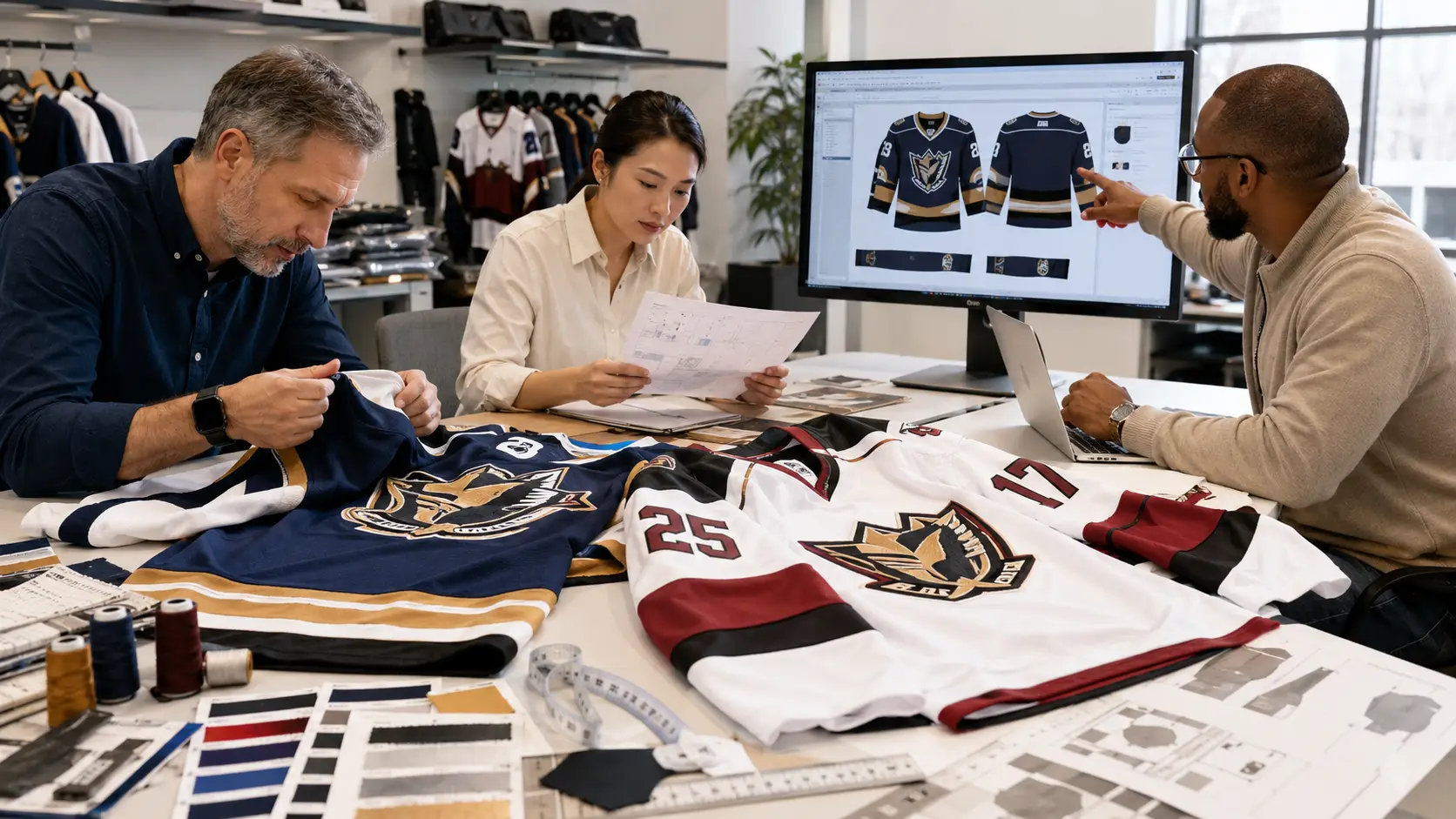
Hockey jersey manufacturers produce custom uniforms for teams, clubs, schools, leagues, retailers, and sportswear brands. A reliable supplier should offer hockey-specific sizing, suitable fabrics, flexible customization, consistent quality control, clear minimum order requirements, and realistic production timelines.
Buyers searching for a dependable supplier should compare actual manufacturing capabilities rather than choosing solely on price. Companies sourcing from a custom clothing manufacturer should consider product quality, customization methods, sampling, sizing, communication, production capacity, and delivery requirements before committing to a bulk order.
What Should You Look for in Hockey Jersey Manufacturers?
The best hockey jersey manufacturer is one that consistently meets the jersey specifications your team or business requires.
That includes more than adding a logo and player number to a standard shirt. Hockey jerseys need adequate room for protective equipment, appropriate sleeve dimensions, durable seams, accurate graphics, and consistent sizing across the order.
Buyers should evaluate:
- Hockey-specific garment construction
- Fabric options
- Sublimation and other decoration methods
- Stitching quality
- Custom names and numbers
- Minimum order quantities
- Samples
- Production timelines
- Quality control
- Packaging
- Shipping
- Repeat-order capabilities
Before comparing suppliers, it can also help to review available custom hockey jersey manufacturing options to understand the range of styles that can be developed or sourced.
The best supplier for a local hockey team may not be the best supplier for a large retailer. Match the manufacturer to your actual purchasing requirements.
What Do Hockey Jersey Manufacturers Do?
Hockey jersey manufacturers turn a buyer’s design and specifications into finished garments.
Depending on the factory and order type, services may include:
- Product development
- Fabric sourcing
- Jersey pattern development
- Digital mockups
- Custom colors
- Sublimation printing
- Embroidery
- Tackle twill
- Team crests
- Player names and numbers
- Custom collars
- Reinforced construction
- Private labels
- Care labels
- Packaging
- Bulk production
- Quality inspection
Some manufacturers focus on individual teams and clubs. Others operate as OEM, private-label, or wholesale suppliers serving businesses.
Buyers placing larger orders should review the manufacturer’s company profile and production information as part of their supplier evaluation.
Understanding the factory’s normal order structure helps prevent problems later.
What Makes a High-Quality Hockey Jersey?
A high-quality hockey jersey should combine fit, durability, comfort, construction, and accurate branding.
Hockey-Specific Fit
Hockey jerseys are normally worn over protective equipment. That makes fit different from ordinary shirts or standard athletic tops.
The garment needs enough space through the:
- Shoulders
- Chest
- Arms
- Armholes
- Sleeves
However, simply making the jersey oversized is not the answer.
Excess fabric can affect comfort and appearance. A properly developed hockey pattern should provide room where players need it while maintaining balanced proportions.
Always request a size chart and, where possible, test a physical sample over the equipment players will actually wear.
Suitable Jersey Fabric
Most modern hockey jerseys use polyester-based performance fabrics.
When comparing materials, consider:
- Durability
- Breathability
- Structure
- Fabric weight
- Comfort
- Moisture management
- Printing compatibility
- Resistance to regular washing
There is no single perfect fabric for every buyer.
A practice jersey, a premium team uniform, a retail jersey, and a promotional jersey may each require a different material specification.
Manufacturers offering broader custom sports jersey manufacturing may also have multiple fabric and construction options available across different sportswear programs.
Strong Stitching and Construction
Inspect areas exposed to regular movement and stress.
These include:
- Shoulder seams
- Armholes
- Sleeves
- Side seams
- Collar
- Hem
- Reinforced panels
Look for even stitching, secure seams, clean finishing, and consistent panel alignment.
Loose threads, puckered seams, uneven stitching, and poorly aligned panels can indicate inadequate production control.
Accurate Team Branding
A custom jersey should reproduce the approved design consistently.
Before production, verify:
- Team logo
- Brand logo
- Player names
- Player numbers
- Team colors
- Sponsor logos
- Captain markings
- Sleeve graphics
- Front layout
- Back layout
An error that seems small on a digital mockup can become expensive when repeated across a bulk order.
Types of Hockey Jerseys Available
Different hockey programs require different jersey styles.
Custom Sublimated Hockey Jerseys
Sublimation is widely used for custom teamwear because it allows detailed graphics to become part of compatible polyester fabric.
It works especially well for:
- Multiple colors
- Gradients
- Complex graphics
- Sponsor logos
- Team patterns
- Player numbers
- Player names
- Large printed areas
Because the design is integrated into the fabric rather than added as a thick surface layer, sublimation can provide a smooth finished appearance.
If you’re exploring traditional ice hockey styles, you can review an example of ice hockey jersey manufacturing when developing your specifications.
Tackle Twill Hockey Jerseys
Tackle twill uses fabric components that are cut and sewn onto a jersey.
It is commonly associated with the raised lettering, numbers, and crests seen on traditional hockey uniforms.
Tackle twill may be suitable for:
- Premium uniforms
- Traditional designs
- Retail jerseys
- Commemorative jerseys
- Team crests
- Large player numbers
It adds more material and construction work than fully sublimated graphics, so buyers should compare appearance, production requirements, and cost.
Embroidered Hockey Jerseys
Embroidery can be used for certain badges, logos, or decorative elements.
It creates a textured finish and may work well for smaller design areas.
Large or highly complex graphics may be better suited to sublimation or another decoration technique.
Practice Hockey Jerseys
Practice jerseys usually prioritize function, simplicity, and durability.
Teams may use them for:
- Training
- Scrimmages
- Tryouts
- Hockey camps
- Youth development
- Player identification
Buyers who need a simpler uniform can compare specifications with a practice hockey jersey before deciding how much customization is necessary.
Sublimation vs. Tackle Twill Hockey Jerseys
Neither customization method is automatically better.
The best choice depends on the intended appearance, design complexity, budget, and use.
| Feature | Sublimation | Tackle Twill |
| Surface | Smooth | Raised and textured |
| Detailed graphics | Excellent | More limited |
| Gradients | Easy | Not ideal |
| Added decoration weight | Minimal | Higher |
| Traditional appearance | Moderate | Strong |
| Names and numbers | Easy to integrate | Applied separately |
| All-over graphics | Excellent | Impractical |
| Best suited for | Modern custom designs | Traditional premium designs |
Ask manufacturers for physical examples whenever possible.
Images can help narrow the options, but a sample gives you a better understanding of fabric feel, stitching, print quality, and overall construction.
How to Choose a Hockey Jersey Manufacturer
A structured comparison helps buyers avoid making decisions based solely on promotional claims.
1. Define Your Jersey Requirements
Create a written product specification before requesting quotes.
Include:
- Total quantity
- Adult sizes
- Youth sizes
- Fabric
- Design
- Team colors
- Collar style
- Decoration method
- Names
- Numbers
- Logos
- Sponsor graphics
- Packaging
- Destination
- Required delivery date
Retailers and private-label brands may also need:
- Neck labels
- Care labels
- Hangtags
- Barcodes
- Polybags
- Custom packaging
Sending the same specification to each supplier makes it easier to compare quotations.
2. Look for Relevant Manufacturing Experience
A general clothing supplier may not have the same experience as a dedicated sportswear manufacturer.
Look for demonstrated experience with:
- Hockey jerseys
- Teamwear
- Polyester performance fabrics
- Sublimation
- Personalized uniforms
- Bulk jersey production
- Custom sizing
For buyers targeting the North American market, reviewing examples such as a USA hockey jersey can also help when discussing design, sizing, and customization requirements with a supplier.
3. Request a Physical Sample
A sample is one of the most valuable tools in supplier selection.
Check:
- Fabric quality
- Weight
- Fit
- Printing
- Stitching
- Collar
- Sleeve dimensions
- Logo reproduction
- Color
- Overall finishing
For substantial orders, consider requiring a pre-production sample before approving bulk manufacturing.
4. Test the Sample Over Hockey Equipment
Do not evaluate fit while wearing only normal clothing.
Have players test the jersey while wearing shoulder pads and other relevant protective equipment.
Check:
- Shoulder movement
- Arm movement
- Chest room
- Sleeve length
- Body length
- Collar comfort
A visually impressive jersey is not useful if it restricts players on the ice.
5. Confirm the Minimum Order Quantity
MOQ means minimum order quantity.
Ask whether the minimum applies:
- Per style
- Per design
- Per color
- Per size
- Per total order
Minimums can vary across production programs, so verify the current requirements directly rather than assuming a single published number applies to every product.
6. Review Customization Capabilities
Ask which methods the manufacturer can provide.
Possible options include:
- Full sublimation
- Partial sublimation
- Tackle twill
- Embroidery
- Patches
- Custom names
- Custom numbers
- Sponsor logos
- Private labels
Different hockey jersey styles may require different approaches. If you’re looking for another reference point, please review the site’s hockey jersey product range before finalizing the artwork.
7. Check Artwork Before Approval
A supplier can manufacture exactly what you approve, including mistakes.
Review:
- Player names
- Player numbers
- Logo placement
- Team colors
- Sponsor positions
- Fonts
- Sleeve graphics
- Front layout
- Back layout
Have more than one person verify the roster before signing off.
8. Confirm Production Timing
Custom hockey jerseys may pass through several stages:
- Product specification
- Artwork preparation
- Digital mockup
- Sample development
- Approval
- Fabric preparation
- Printing or decoration
- Cutting
- Sewing
- Quality inspection
- Packing
- Shipping
Ask exactly when the quoted production timeline begins.
For example, the clock may start after final artwork approval, sample approval, material confirmation, or payment rather than on the date of the first inquiry.
9. Compare the Complete Quote
Do not compare only the base price per jersey.
Ask whether the quote includes:
- Manufacturing
- Names
- Numbers
- Logos
- Artwork setup
- Samples
- Labels
- Packaging
- Shipping
- Taxes or duties where applicable
A complete quote gives you a much more realistic basis for comparing suppliers.
What Affects the Cost of Custom Hockey Jerseys?
There is no universal price for a custom hockey jersey.
Several variables affect production cost.
Quantity
Order quantity affects manufacturing efficiency and the distribution of development costs across the order.
Fabric
Fabric cost varies according to material composition, weight, construction, finishing, and performance characteristics.
Customization Method
Full sublimation, embroidery, patches, and multilayer tackle twill require different materials, equipment, and labor.
Individual Personalization
Player-specific names and numbers may affect pricing depending on the production method.
Custom Construction
Special collars, custom panels, reinforced sections, unusual sizing, and custom patterns can add development or manufacturing requirements.
Sampling
Some manufacturing programs charge separately for samples and development.
Others may structure these costs differently.
Confirm this before beginning the project.
Shipping
International freight, packaging requirements, destination, shipment size, and delivery method can significantly affect landed cost.
If you’re researching bulk sourcing, you may also find a broader guide to wholesale hockey jersey manufacturing helpful as you prepare questions for prospective suppliers.
Team Orders vs. Wholesale and Private-Label Manufacturing
Not every supplier serves the same type of customer.
Team Jersey Suppliers
Direct team suppliers may work well for:
- Hockey clubs
- School teams
- Recreational leagues
- Youth teams
- Tournament teams
Important services may include design support, player personalization, roster management, and replacement ordering.
Wholesale Hockey Jersey Manufacturers
Wholesale production is usually more appropriate for:
- Uniform dealers
- Distributors
- Retailers
- Sporting goods businesses
- Promotional apparel companies
These buyers may prioritize bulk production, repeatability, packaging, and consistent specifications.
Private-Label Manufacturers
Private-label buyers often require more product-development support.
Requirements can include:
- Custom patterns
- Custom fabrics
- Brand labels
- Care labels
- Technical specifications
- Packaging
- Product samples
- Repeat production
If you operate a sportswear brand, make sure the supplier can support your actual development process rather than simply adding your logo to an existing jersey.
Domestic vs. Overseas Hockey Jersey Manufacturers
Both domestic and overseas suppliers can be suitable.
Domestic Suppliers May Offer
- Easier communication
- Shorter shipping distances
- Faster sample coordination
- Easier facility visits
- Simpler local logistics
Overseas Suppliers May Offer
- Different production capabilities
- Larger-scale manufacturing
- OEM programs
- Private-label production
- Broader sourcing options
Do not select a supplier based on geography alone.
Compare:
- Product quality
- Total landed cost
- MOQ
- Sampling
- Communication
- Customization
- Production capacity
- Quality control
- Lead time
- Shipping
- Reorder support
Quality Control Questions to Ask
Quality control should be discussed before production begins.
Ask:
- How are incoming materials checked?
- Are measurements checked against specifications?
- How are colors verified?
- How are names and numbers checked?
- When are seams inspected?
- Is there a final inspection?
- How are defective products handled?
- Can buyers approve a pre-production sample?
- Can inspection reports or product measurements be provided?
- What happens if the finished order differs from the approved sample?
Specific answers are more useful than broad statements about “high quality.”
Common Mistakes When Ordering Hockey Jerseys
Choosing on Price Alone
A low quote may reflect a different fabric, construction method, level of customization, or service package.
Better approach: Give each manufacturer the same specifications and compare like-for-like products.
Skipping the Sample
Website images cannot show exact fabric feel, fit, stitching, or construction.
Better approach: Inspect a physical sample before approving a significant bulk order.
Ignoring Hockey-Specific Fit
A standard shirt pattern may not provide enough room for protective equipment.
Better approach: Test the jersey over actual hockey pads.
Approving an Incorrect Roster
One spelling error can be repeated throughout the order.
Better approach: Have at least two people independently check all player names and numbers.
Ordering Too Close to the Season
Sampling, revisions, manufacturing, inspection, and shipping all require time.
Better approach: Plan backward from the required delivery date and leave room for changes.
Forgetting About Reorders
Teams may add players or need replacement jerseys during the season.
Better approach: Ask the manufacturer how individual or smaller repeat orders are handled.
Hockey Jersey Manufacturer Checklist
Before committing to a supplier, confirm:
- The supplier has relevant hockey jersey experience
- The proposed fabric matches your intended use
- The pattern allows room for protective equipment
- The size chart has been reviewed
- Customization options meet your requirements
- A physical sample has been checked
- The minimum order is acceptable
- Artwork has been approved
- Player names and numbers have been verified
- Pricing includes required customization
- Sample costs are understood
- Production timing is documented
- Shipping terms are clear
- Quality-control procedures have been discussed
- Defect policies are understood
- Repeat-order options have been confirmed
How to Verify a Hockey Jersey Supplier
Business verification is especially important when placing a large wholesale or international order.
Look for:
- Clear company information
- Real contact details
- Relevant product pages
- Manufacturing information
- Product samples
- Written quotations
- Transparent production terms
- Clear communication
- Quality-control procedures
- Shipping information
A manufacturer’s website is only one part of the evaluation.
Samples, specifications, written terms, direct communication, and appropriate business checks should also form part of your sourcing process.
Which Hockey Jersey Manufacturer Is Right for You?
The answer depends on what you are buying.
Small hockey teams may prioritize manageable order quantities, individual names and numbers, simple communication, and replacement jerseys.
Schools and leagues may prioritize consistent sizing, durability, repeat production, and reliable scheduling.
Retailers and distributors may focus on bulk production, packaging, consistency, and wholesale purchasing requirements.
Sportswear brands may need technical product development, private labeling, sampling, custom specifications, and scalable production.
The best manufacturer is therefore not simply the company offering the lowest price.
The supplier can reliably meet your product specifications, quantity, quality level, customization, budget, and schedule.
Frequently Asked Questions
What do hockey jersey manufacturers produce?
Hockey jersey manufacturers produce customized jerseys for teams, leagues, clubs, retailers, and sportswear businesses. Depending on the supplier, customization can include colors, logos, names, numbers, sublimation, embroidery, tackle twill, custom labels, and packaging.
What material is commonly used for hockey jerseys?
Polyester-based fabrics are commonly used for hockey jerseys because they offer the durability, structure, breathability, and printability required for sportswear. The correct material depends on the intended product and performance requirements.
Is sublimation good for hockey jerseys?
Yes. Sublimation is well suited to polyester hockey jerseys that require detailed graphics, multiple colors, player personalization, and large printed areas. Buyers should still evaluate the underlying fabric and garment construction.
What is the difference between sublimation and tackle twill?
Sublimation integrates graphics into compatible fabric, creating a smooth surface. Tackle twill uses cut fabric letters, numbers, or logo pieces that are sewn onto the jersey, creating a more raised and traditional appearance.
How long does hockey jersey manufacturing take?
There is no universal production timeline. Timing depends on the product specification, sample development, approvals, order quantity, materials, customization method, manufacturing capacity, quality control, and shipping.
Should I request a sample before ordering hockey jerseys in bulk?
Yes. A sample allows you to evaluate fabric, sizing, print quality, colors, stitching, decoration, and construction before committing to full production.
Compare Hockey Jersey Manufacturers Before Ordering
Choosing hockey jersey manufacturers should begin with a clear specification rather than a search for the lowest unit price.
Define your quantity, sizes, fit, fabric, design, customization method, player details, branding, packaging, delivery date, and shipping requirements.
Then compare manufacturers using the same brief.
Request samples. Test sizing over hockey equipment. Inspect stitching and graphics. Verify names and numbers. Confirm production timing. Review the complete quotation and ask how defects or repeat orders are handled.
When you are ready to discuss specifications, quantities, sampling, or quotation requirements, you can contact Minmax Textile with the details of your hockey jersey project.
Careful supplier evaluation gives teams, leagues, retailers, distributors, and sportswear brands a stronger foundation for choosing a hockey jersey manufacturing partner.