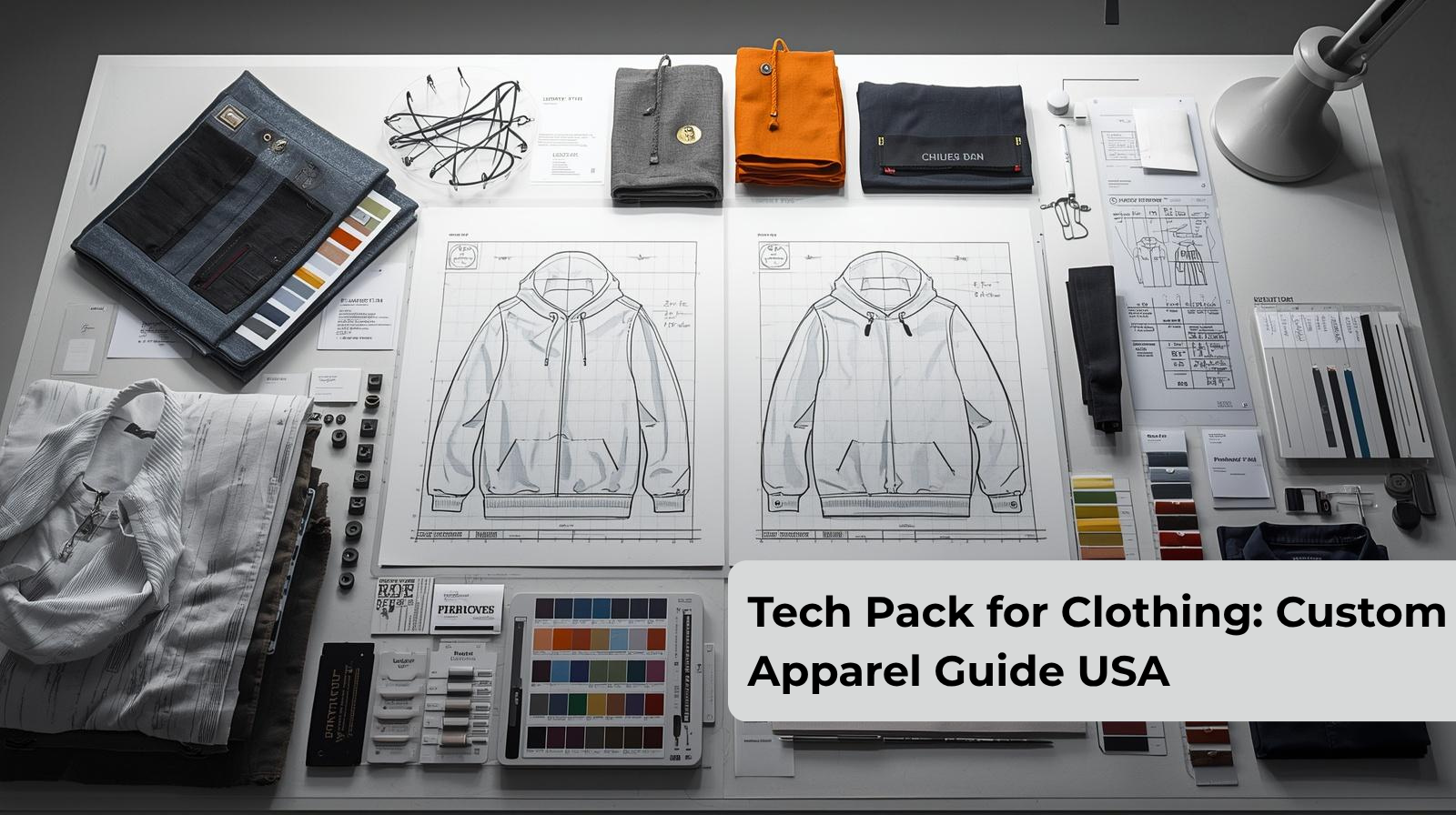
A tech pack for clothing is a detailed production document that outlines exactly how to make a garment. It includes sketches, measurements, fabrics, trims, colors, stitching, labels, packaging, and quality standards. For custom clothing orders, a strong tech pack reduces mistakes, speeds up sampling, and helps brands get accurate pricing.
Why Your Clothing Idea Needs More Than a Sketch
Let’s say you want to launch a custom hoodie line in the United States. You have the design in your head. Maybe you even have a rough drawing, a Pinterest board, or a sample hoodie you love. You send it to a manufacturer and say, “Can you make something like this?”
That sounds simple, but in apparel production, “something like this” can quickly become expensive.
The fabric might be too light. The fit may come back boxy instead of oversized. The pocket placement could be off by an inch. The print may crack after washing. The label may be sewn in the wrong spot. And when the first sample arrives, you may realize the manufacturer did exactly what they thought you wanted, not what you actually meant.
That is where a clothing tech pack comes in.
A tech pack turns your idea into clear production instructions. It acts like a blueprint for your garment, whether you are ordering custom T-shirts, hoodies, leggings, uniforms, workwear, kidswear, streetwear, or private-label fashion pieces.
At Minmax Textile, we see this all the time: brands that come prepared with a clean tech pack usually move faster, receive better samples, and get more accurate quotes. Brands without one often spend extra time explaining, correcting, and resampling.
This guide breaks down what a tech pack is, why it matters, what to include, and how to create one for custom clothing orders in the USA, UK, Canada, France, and Germany.
What Is a Tech Pack for Clothing?
A tech pack for clothing is a complete document that explains how a garment should be made. It gives your clothing manufacturer all the technical details needed to produce your design correctly.
Think of it as the instruction manual for your garment.
A clothing tech pack usually includes:
- Flat sketches or technical drawings
- Measurement chart
- Fabric details
- Trim details
- Color codes
- Stitching and construction notes
- Print, embroidery, or embellishment instructions
- Label and packaging details
- Size grading
- Bill of materials
- Quality control requirements
For example, if you are making a custom oversized T-shirt, your tech pack should not just say “oversized fit.” It should show the exact chest width, body length, shoulder width, sleeve length, fabric GSM, neckline rib quality, stitching type, print size, print placement, and packaging method.
That level of detail helps everyone stay on the same page.
Why a Tech Pack Matters for Custom Clothing Orders
A tech pack is not just a “nice-to-have” document. It can protect your budget, timeline, and product quality.
In the U.S. apparel market, e-commerce and demand for custom products continue to grow. The U.S. Census Bureau reported that retail e-commerce sales accounted for 16.4% of total U.S. retail sales in Q4 2024. For clothing brands selling online, that means customers often judge your product without first touching it. Fit, fabric, photos, and reviews matter more than ever.
A good tech pack helps you create a product that matches the promise on your website.
1. It Reduces Costly Mistakes
Manufacturers cannot read your mind. If a detail is missing, they may make their best guess.
That guess might be wrong.
A tech pack reduces confusion by spelling out every important detail before production begins. This can prevent common issues like:
- Wrong fabric weight
- Incorrect sizing
- Bad print placement
- Poor stitching choice
- Mismatched colors
- Incorrect label placement
- Packaging mistakes
One small error can become a big problem when multiplied across 300, 1,000, or 5,000 units.
2. It Helps You Get Accurate Pricing
When you ask for a quote without a tech pack, the price is often just an estimate.
A manufacturer needs to know the fabric, trims, stitching, print method, sizing, order quantity, and finishing details before providing an accurate cost estimate.
For example, a basic cotton T-shirt and a heavyweight enzyme-washed oversized T-shirt may look similar in photos, but they cost very different amounts to produce.
A complete tech pack helps factories calculate:
- Fabric consumption
- Trim cost
- Labor time
- Printing or embroidery cost
- Packaging cost
- Waste allowance
- Production complexity
The clearer your tech pack, the more reliable your quote.
3. It Speeds Up Sampling
Sampling is where many clothing projects slow down.
Without clear instructions, you may go through sample after sample just to avoidable mistakes. A well-prepared apparel tech pack gives the sample room a strong starting point.
This does not mean your first sample will always be perfect. Apparel development usually involves adjustments. But a tech pack makes those adjustments more focused and professional.
4. It Improves Communication With Manufacturers
If you are based in New York, Los Angeles, Toronto, London, Paris, Berlin, or anywhere else, you may work with a manufacturer in another country. Different time zones, languages, and production habits can create confusion.
A tech pack creates a shared reference point.
Instead of long email chains like “make the sleeve a little shorter,” you can say, “Revise sleeve length from 8.5 inches to 8 inches as shown in the updated measurement chart.”
That is much easier to track.
5. It Supports Quality Control
A tech pack gives your quality control team a checklist. They can compare the finished garment against the original specs.
This is especially important for custom clothing orders where consistency matters. If you are supplying uniforms, corporate apparel, school merch, gym wear, or retail stock, customers expect every piece to look and fit the same.
What Should Be Included in a Clothing Tech Pack?
A complete tech pack for clothing should answer one simple question:
“What does the manufacturer need to know to make this garment correctly?”
Here are the main sections.
1. Cover Page and Style Information
Start with a simple overview of the product.
Include:
- Brand name
- Style name
- Style number
- Product category
- Season or collection
- Date created
- Version number
- Contact information
Example:
Brand: Minmax Textile Client Sample
Style Name: Heavyweight Oversized Hoodie
Style Number: HD-2401
Category: Men’s streetwear hoodie
Season: Fall/Winter
Version: V2 after first sample review
Version control is important. If you update measurements or change fabric later, label the file clearly. This avoids the classic production problem: someone using an old file by mistake.
2. Technical Flat Sketches
A flat sketch is a clean front and back drawing of the garment. It shows the garment laid flat, without a model.
You do not need fashion illustration skills here. In fact, dramatic fashion sketches are less useful for production. A manufacturer needs clear technical drawings.
Your flat sketch should show:
- Front view
- Back view
- Side view if needed
- Pocket shape
- Neckline
- Cuffs
- Hem
- Zippers
- Buttons
- Seams
- Panels
- Drawcords
- Stitch lines
- Print or embroidery placement
For a custom hoodie, your flat sketch might show the hood seam, kangaroo pocket, ribbed cuffs, ribbed hem, drawcord eyelets, sleeve seams, and back neck label placement.
3. Measurement Specification Sheet
This is one of the most important parts of a tech pack.
A measurement spec sheet tells the manufacturer the exact dimensions of the garment. It usually includes a point of measurement, also called POM.
Common POMs include:
- Chest width
- Body length
- Shoulder width
- Sleeve length
- Neck opening
- Armhole
- Bicep width
- Cuff opening
- Hem width
- Waist
- Hip
- Inseam
- Front rise
- Back rise
For each measurement, include the size breakdown.
Here is a simple example for a T-shirt:
| Point of Measurement | S | M | L | XL | Tolerance |
|---|---|---|---|---|---|
| Chest Width | 19″ | 20″ | 21″ | 22″ | +/- 0.5″ |
| Body Length | 27″ | 28″ | 29″ | 30″ | +/- 0.5″ |
| Shoulder Width | 17″ | 18″ | 19″ | 20″ | +/- 0.25″ |
| Sleeve Length | 7.5″ | 8″ | 8.5″ | 9″ | +/- 0.25″ |
A tolerance is the acceptable difference in measurement. People and machines sew clothing, so tiny variations happen. Setting tolerance helps define what is acceptable.
4. Fabric Details
Fabric choice affects the look, feel, durability, fit, and cost of the garment.
Your tech pack should include:
- Fabric type
- Fiber content
- Fabric weight
- Knit or woven structure
- Stretch percentage if needed
- Finish or wash
- Color
- Supplier reference, if available
Example:
Main Fabric: 100% cotton fleece
Weight: 380 GSM
Construction: Brushed back fleece
Finish: Garment washed
Color: Pantone Black 6 C
Use: Hoodie body, sleeves, and hood
For USA streetwear brands, fabric weight is often a big selling point. A 180 GSM T-shirt feels very different from a 260 GSM heavyweight tee. The tech pack should make that clear.
5. Bill of Materials
The bill of materials, often called BOM, lists every material used in the garment.
This includes:
- Main fabric
- Contrast fabric
- Rib
- Lining
- Thread
- Buttons
- Zippers
- Drawcords
- Eyelets
- Labels
- Tags
- Elastic
- Interlining
- Packaging materials
A BOM keeps sourcing organized. It also helps the manufacturer calculate cost and avoid missing trims.
Example BOM for a hoodie:
| Item | Description | Color | Placement |
|---|---|---|---|
| Main Fabric | 380 GSM cotton fleece | Black | Body and sleeves |
| Rib | 2×2 cotton rib | Black | Cuffs and hem |
| Drawcord | Flat cotton drawcord | Black | Hood |
| Eyelets | Metal eyelets | Gunmetal | Hood opening |
| Main Label | Woven label | Black/White | Back neck |
| Hangtag | Paper hangtag | Brand color | Attached to neck label |
6. Color Standards
Color can be tricky. “Navy blue” may mean five different things to five different people.
Use color standards when possible. Common references include:
- Pantone color codes
- Lab dips
- Physical color swatches
- Approved sample references
If your brand color is important, do not rely only on screen images. Colors can look different on phones, laptops, and factory monitors.
For production, physical approval is often best. A lab dip lets you approve the fabric color before bulk dyeing.
7. Stitching and Construction Details
This section explains how the garment should be sewn.
Include details such as:
- Seam type
- Stitch type
- Stitch density
- Thread color
- Reinforcement points
- Edge finishing
- Hem finish
- Topstitching
- Bar tacks
- Overlock or coverstitch use
Example:
Neck Seam: 4-thread overlock
Shoulder Seam: Reinforced with shoulder tape
Sleeve Hem: Double needle coverstitch
Pocket Opening: Bar tack at both ends
Thread Color: Match body fabric
This is where experience matters. If you are not sure which stitching method is best, ask your clothing manufacturer. A good manufacturer can recommend construction methods based on fabric, garment type, and target price.
8. Print, Embroidery, and Artwork Placement
If your garment includes graphics, logos, patches, screen printing, DTG printing, sublimation, heat transfer, or embroidery, your tech pack should explain it clearly.
Include:
- Artwork file name
- Artwork size
- Placement measurements
- Color codes
- Print technique
- Embroidery thread colors
- Patch material
- Special finish
- Care instructions
Example:
Front Chest Print: Screen print, 4 inches wide
Placement: Centered, 3 inches below neck seam
Color: Pantone 185 C
Artwork File: MT-front-logo.ai
Finish: Soft-hand plastisol
Do not just paste a logo onto a mockup and hope the factory understands the size. Always include measurements.
9. Labels, Tags, and Branding
Labels are small details, but they affect the customer experience.
Your tech pack should include:
- Main neck label
- Size label
- Care label
- Country of origin label
- Hangtag
- Barcode sticker
- Polybag sticker
- Woven patch
- Heat transfer label
For U.S. orders, care labeling and fiber content are especially important. If you plan to sell in the USA, UK, Canada, France, or Germany, make sure your labeling meets the market’s requirements.
A basic care label may include:
- Fiber content
- Washing instructions
- Country of origin
- Size
- RN number, if applicable for the U.S.
- Brand name
When in doubt, get compliance advice before bulk production.
10. Packaging Instructions
Packaging affects shipping, retail presentation, and customer satisfaction.
Include:
- Folding method
- Polybag size
- Sticker placement
- Carton quantity
- Carton marking
- Hanger requirement
- Tissue paper
- Insert card
- Barcode label
- SKU sticker
For e-commerce brands in the USA, packaging can directly affect reviews. A wrinkled hoodie thrown into a loose bag does not create the same impression as a neatly folded garment in a labeled polybag.
11. Size Grading
Size grading explains how the garment changes from one size to another.
For example, your medium hoodie may be the base size. From there, the small is smaller by a fixed amount, and the large is larger by a fixed amount.
A clear grading rule keeps sizing consistent across the full range.
Common size ranges include:
- XS to 2XL
- S to 5XL
- Women’s XS to XL
- Kids 2T to 12
- Plus-size ranges
- Unisex sizing
If you sell in multiple countries, remember that sizing expectations can differ. A U.S. medium may not fit the same as a European medium. If you target the USA, UK, Canada, France, and Germany, include a size chart for your customers and a technical size spec for production.
12. Quality Control Standards
Your tech pack should define what “approved quality” means.
Include quality notes such as:
- Measurement tolerance
- Fabric defects allowed or rejected
- Print durability expectations
- Stitching requirements
- Color matching standard
- Label placement tolerance
- Packaging standard
- Wash test requirements
Example:
Print Quality: No cracking after wash test
Measurement Tolerance: Follow the spec chart
Stitching: No skipped stitches, loose threads, or open seams
Packaging: Each garment is folded and packed by size and color
This helps the manufacturer and inspection team check the order before shipping.
How to Create a Tech Pack for Custom Clothing Orders
Now let’s turn the pieces into a practical process.
Step 1: Define the Product Clearly
Start with the basics.
Ask yourself:
- What type of garment am I making?
- Who is it for?
- What fit do I want?
- What price point am I targeting?
- Where will I sell it?
- Is it for retail, uniforms, merch, or private label?
- What makes it different from similar products?
Example:
“I want a premium oversized hoodie for a U.S. streetwear brand. It should feel heavyweight, have a relaxed drop-shoulder fit, use soft cotton fleece, and retail between $85 and $110.”
That description gives your manufacturer a much better direction than “I need a hoodie.”
Step 2: Create or Collect Reference Samples
A reference sample can help explain fit, fabric, or construction.
You can use:
- A garment you already own
- A competitor product
- A previous sample
- A fabric swatch
- A photo reference
- A mockup
But be careful. Do not copy another brand’s protected design. Use references to explain quality, fit, and construction, not to duplicate someone else’s product.
Step 3: Make Technical Flat Sketches
Create front and back flat sketches. You can use Adobe Illustrator, tech pack software, or even a clean template if you are just starting out.
Keep the sketch simple and clear.
Add callouts for important details, such as:
- Pocket size
- Stitching
- Seams
- Rib panels
- Zipper length
- Logo placement
- Special trims
Step 4: Build the Measurement Chart
Choose a base size. For many U.S. brands, a sample size of 1,000 is common, but this depends on your market.
Measure a reference garment if you have one. Then adjust the measurements based on your desired fit.
Do not guess too much here. Fit is one of the main reasons customers return clothing.
For custom clothing orders, always include:
- Base size measurements
- Full-size grading
- Tolerance
- Measurement diagrams, if possible
Step 5: Choose Fabrics and Trims
Select the materials that match your design, price point, and customer expectations.
For example:
- Lightweight cotton jersey for budget T-shirts
- Heavyweight cotton jersey for premium streetwear tees
- Polyester-spandex blends for activewear
- Cotton fleece for hoodies and sweatpants
- Twill or canvas for workwear
- French terry for lighter sweatshirts
If you are unsure, ask Minmax Textile for fabric recommendations based on your target market and order quantity.
Step 6: Add Artwork and Branding Details
Prepare your artwork in production-ready formats, such as AI, EPS, PDF, or high-resolution PNG when suitable.
Include exact placement and size.
For example:
- Front logo: 10 inches wide, centered
- Left chest embroidery: 3 inches wide, 7 inches below the shoulder
- Back print: 12 inches wide, centered
- Sleeve print: 2 inches from cuff edge
Clear placement instructions help avoid awkward-looking samples.
Step 7: Add Packaging and Labeling Instructions
Decide how you want the finished product packed.
For online brands, include SKU stickers and size labels. For retail stores, you may need hangtags, barcodes, and carton labeling.
A basic e-commerce packaging setup may include:
- Folded garment
- Clear polybag
- Size sticker
- SKU barcode
- Carton by color and size
- Packing list
Step 8: Review the Tech Pack Before Sending It
Before sending your tech pack to a manufacturer, check it as a production manager would.
Ask:
- Are all measurements included?
- Are the fabric details clear?
- Are colors defined?
- Are trims listed?
- Are print files named?
- Are labels and packaging explained?
- Is the latest version clearly marked?
- Are there any conflicting instructions?
A 20-minute review can save weeks of back-and-forth later.
Tech Pack Example: Custom Hoodie Order
Here is a simple example of what a custom hoodie tech pack may include.
Product: Oversized pullover hoodie
Market: USA streetwear brand
Fabric: 380 GSM cotton fleece
Fit: Drop shoulder, relaxed body
Color: Washed black
Print: Front chest screen print
Label: Woven neck label and care label
Packaging: Folded in a polybag with a size sticker
Sizes: S to 2XL
MOQ: Based on factory requirements
Quality Notes: No loose threads, no print cracking, consistent wash effect
This is the kind of detail that helps a manufacturer properly quote and sample.
Common Tech Pack Mistakes to Avoid
Even experienced brands make tech pack mistakes. Here are the ones to watch.
Mistake 1: Using Vague Words
Words like “premium,” “soft,” “oversized,” and “high quality” are useful for direction, but they are not enough for production.
Instead of saying “heavy fabric,” say “260 GSM cotton jersey.”
Instead of saying “small logo,” say “3-inch-wide embroidery.”
Mistake 2: Forgetting Measurement Tolerance
Without tolerance, it is hard to judge whether a garment passed or failed inspection.
Always include acceptable variation.
Mistake 3: Not Updating Version Numbers
If you revise the tech pack, change the version number and date.
Example:
- V1: Initial tech pack
- V2: Updated measurements after the first sample
- V3: Final approved production version
Mistake 4: Missing Label and Packaging Details
Many brands focus on the garment and forget the finishing details. But labels, hangtags, and packaging affect compliance, branding, and customer experience.
Mistake 5: Sending Low-Quality Artwork
Blurry logos and screenshots are not production files. Use clean, high-resolution artwork.
Mistake 6: Not Asking the Manufacturer for Feedback
A good manufacturer can often spot issues before production. Your fabric choice may not work well with your print method. Your seam construction may be too expensive for your target price.
Use their expertise.
Local Insights for the USA, UK, Canada, France, and Germany
A tech pack is useful anywhere, but your target market affects how you should prepare it.
USA
The U.S. clothing market is competitive, and customer reviews matter. If you sell through Shopify, Amazon, Etsy, boutiques, or your own e-commerce site, product consistency is key.
For USA brands, pay close attention to:
- Fit accuracy
- Size chart clarity
- Fabric weight
- Care labels
- Returns caused by sizing issues
- Packaging quality
- Fast sampling and replenishment
A clear tech pack helps you avoid negative reviews caused by inconsistent sizing or poor finishing.
UK
UK customers often expect clean sizing information and strong value for money. If you sell in the UK, make sure your size conversions are clear, and your garment measurements match your customer-facing size chart.
Canada
Canada has a mix of U.S. and international sizing expectations. If you sell in both the USA and Canada, keep one consistent production spec and adapt your website size guide where needed.
France
For France, style, fit, and fabric feel are important. If your product has a more fashion-led design, include clear notes about drape, silhouette, and finishing.
Germany
German buyers often value durability, function, and clear product information. For workwear, uniforms, outdoor apparel, and basics, quality control details should be especially clear.
Local SEO Tips for Custom Clothing Manufacturers
If you are a clothing manufacturer, apparel supplier, or private-label clothing partner, local SEO can help buyers find you.
Google says local rankings are based mainly on relevance, distance, and prominence. That means your online presence should clearly explain what you do, where you serve, and why customers trust you.
For a brand like Minmax Textile, useful local SEO actions include:
- Keep your Google Business Profile complete and accurate
- Add service areas such as the USA, UK, Canada, France, and Germany where relevant
- Use service keywords like custom clothing manufacturer, private label apparel, and tech pack support
- Add real photos of products, samples, fabrics, and production work
- Collect honest customer reviews
- Respond to reviews professionally
- List the business in trusted local and industry directories
- Create location-focused service pages
- Publish helpful guides like this one
Reviews are especially important because buyers want proof before trusting a manufacturer with their first order.
Do You Need a Tech Pack Before Contacting a Manufacturer?
Ideally, yes. But if you do not have one yet, you can still contact a manufacturer for guidance.
At Minmax Textile, many clients come with:
- A rough sketch
- A sample garment
- A mood board
- A logo
- A product idea
- A competitor reference
- A partial tech pack
That is fine. The important thing is to turn those ideas into a clear production document before sampling or bulk production.
If you are serious about launching a clothing line, a tech pack is one of the smartest early investments you can make.
Tech Pack for Clothing: Quick Checklist
Use this checklist before sending your tech pack to a manufacturer.
- Product name and style number
- Front and back flat sketches
- Measurement chart
- Size grading
- Fabric details
- Trim details
- Bill of materials
- Color references
- Stitching notes
- Print or embroidery details
- Label instructions
- Packaging instructions
- Quality control standards
- Version number and date
- Contact information
If your tech pack includes all of these, your manufacturer will have a much clearer path to quote, sample, and produce your order.
FAQ: Tech Pack for Clothing
What is a tech pack for clothing?
A tech pack for clothing is a production document that explains how a garment should be made. It includes sketches, measurements, fabrics, trims, colors, stitching, labels, packaging, and quality standards.
Do I need a tech pack for a custom clothing order?
Yes, you should use a tech pack for custom clothing orders. It helps manufacturers understand your design, provide accurate pricing, create better samples, and reduce production errors.
How much does a clothing tech pack cost?
The cost depends on the garment’s complexity and who creates it. A simple T-shirt tech pack may cost less than a detailed jacket, activewear set, or multi-piece collection. Some brands create their own, while others hire a technical designer.
Can a manufacturer create a tech pack for me?
Some manufacturers can help create or improve a tech pack, especially if you provide sketches, samples, measurements, or reference images. Minmax Textile can guide clients through the details needed for custom clothing production.
What is the difference between a tech pack and a mockup?
A mockup shows how a garment may look visually. A tech pack explains how to make it. A mockup is useful for design presentation, but a tech pack is needed for accurate sampling and production.
Conclusion: A Better Tech Pack Means a Better Garment
A great clothing product does not happen by accident. It comes from clear planning, strong communication, and careful production details.
A tech pack for clothing provides your manufacturer with the blueprint they need to make your garment correctly. It reduces confusion, improves pricing accuracy, speeds up sampling, and helps protect your brand from costly production mistakes.
Whether you are launching a streetwear brand in the USA, creating private-label apparel for the UK, producing uniforms for Canada, or developing fashion products for France and Germany, a solid tech pack gives your project a professional foundation.
If you are ready to create custom clothing and want expert support, Minmax Textile can help turn your idea, sketch, or sample into a production-ready garment.
Contact Minmax Textile today to discuss your custom clothing order and tech pack requirements.