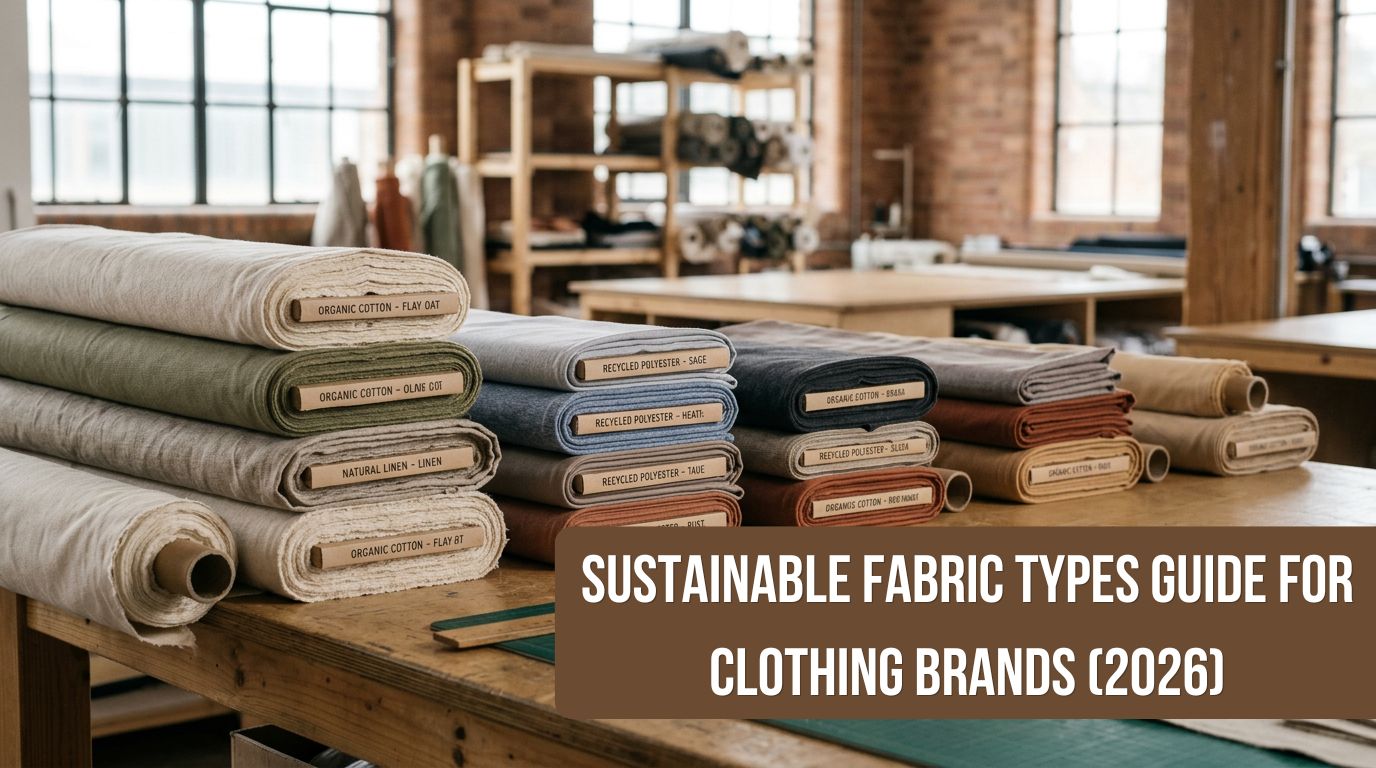
The most sustainable fabric types for clothing brands are organic cotton, recycled polyester (rPET), TENCEL Lyocell, hemp, and recycled or organic wool. Each lowers water use, chemical input, and landfill waste compared to conventional fabrics. The right choice depends on your product category, budget, and the certifications your buyers in the USA, UK, Canada, France, or Germany require, such as GOTS, OEKO-TEX, or GRS.
Why Sustainable Fabric Sourcing Is No Longer Optional
A few years ago, “sustainable fabric” was a marketing line tucked into a hangtag. Today, it is a purchase order requirement. Buyers in New York, London, Toronto, Paris, and Berlin are asking suppliers the same question before they sign a contract: which fiber did you use, and can you prove it?
If you run a clothing brand or source garments for one, you have probably felt this shift firsthand. Retail partners want compliance documents. Customers scan QR codes on hangtags looking for fiber origin. Marketplaces like Amazon and Zalando are starting to flag products with verified sustainability claims higher in search results. The pressure is real, and so is the opportunity.
This guide breaks down the sustainable fabric types that actually matter for apparel manufacturing right now: what they are, how they compare in cost and performance, which certifications back them, and how to choose the right one for your next production run. We work with garment brands across the US, UK, Canada, France, and Germany every week at Minmax Textile, and this article reflects the questions we get asked most often, not just textbook theory.
What Counts as a “Sustainable Fabric”?
A sustainable fabric is a textile produced with reduced environmental impact across its lifecycle, covering raw material sourcing, water and energy use in processing, chemical inputs, and end-of-life biodegradability or recyclability. There is no single global standard that defines the term, which is exactly why third-party certifications matter so much in 2026.
Broadly, sustainable fabrics fall into three categories:
- Natural fibers grown or processed with lower environmental input — organic cotton, hemp, linen, organic wool.
- Recycled fibers made from post-consumer or post-industrial waste — recycled polyester (rPET), recycled nylon, recycled cotton.
- Regenerated or man-made cellulosic fibers produced from wood pulp through closed-loop chemical processes — TENCEL Lyocell, modal, certain types of viscose.
Organic Cotton: The Industry Benchmark
Organic cotton is grown without synthetic pesticides, herbicides, or genetically modified seeds, and it relies on natural rainfall and crop rotation rather than heavy irrigation. For a country like Bangladesh, where conventional cotton farming has historically been water-intensive, the shift toward organic and Better Cotton sourcing has become a genuine competitive advantage for export-focused manufacturers.
Why US, UK, and EU Brands Are Asking for It
According to the Textile Exchange’s annual Organic Cotton Market Report, global organic cotton production has grown steadily year over year as more apparel brands set fiber-replacement targets. Major US retailers, including Patagonia, prAna, and Eileen Fisher, have built entire product lines around GOTS-certified organic cotton, prompting mid-size brands to follow the same playbook to stay competitive on retail shelves.
- Lower water consumption compared to conventional cotton farming, since organic methods typically depend on rain-fed irrigation.
- No synthetic pesticide residue, which matters for baby clothing, intimates, and skin-contact apparel.
- Stronger marketing story for DTC brands targeting environmentally conscious shoppers in the 25–44 age bracket, a segment that consistently ranks sustainability as a top-three purchase factor in US consumer surveys.
The Trade-Off
Organic cotton typically costs 20 to 30 percent more than conventional cotton at the raw fiber stage, and yields can be less predictable depending on the growing region and season. Brands need to plan lead times and minimum order quantities accordingly, which is something we walk every new Minmax Textile client through during the sampling phase.
Recycled Polyester (rPET): Scaling Sustainability Without Sacrificing Performance
Recycled polyester is made primarily from post-consumer plastic bottles or pre-consumer polyester waste, melted down and re-spun into new yarn. It performs almost identically to virgin polyester in durability, moisture-wicking, and color retention, making it the easiest sustainable swap for activewear, outerwear, and performance fabric lines.
Where rPET Makes the Most Sense
- Activewear and athleisure brands that need stretch, durability, and quick-dry performance.
- Outerwear and bag linings where moisture resistance is critical.
- Brands wanting a fast, cost-controlled entry into sustainable sourcing without redesigning their entire fit and feel.
The Global Recycled Standard, or GRS, is the certification buyers usually request to verify recycled content and chain of custody. Without GRS documentation, a “recycled polyester” claim carries little weight with serious retail buyers in Germany or France, where Lieferkettengesetz-style supply chain accountability laws have made traceability paperwork a hard requirement, not a nice-to-have.
A Practical Note on Microplastics
It’s worth being transparent with customers here: recycled polyester still sheds microplastic fibers during washing, just like virgin polyester. If your brand markets eco-credentials heavily, pairing rPET garments with care instructions or recommending a microfiber-catching laundry bag is a small touch that builds genuine trust rather than overselling the fabric’s environmental story.
TENCEL Lyocell and Modal: The Quiet Performers
TENCEL is a branded fiber produced by Austrian company Lenzing from sustainably sourced wood pulp, using a closed-loop solvent process that recovers and reuses over 99 percent of the solvent. The result is a soft, breathable fabric that drapes like silk but biodegrades fully at the end of life.
- Excellent for loungewear, dresses, and shirting where drape and softness matter more than stretch.
- Naturally moisture-absorbent, which makes it popular for warm-climate apparel sold in the southern US market.
- Backed by FSC or PEFC certified forestry sourcing, which satisfies EU deforestation regulation requirements that France and Germany now enforce strictly on imported textiles.
Modal, a close relative of TENCEL, is slightly less expensive and is commonly blended with cotton for t-shirts and underwear, offering a soft hand feel at a lower price point.
Hemp and Linen: Old Fibers, New Demand
Hemp is having a genuine resurgence. It requires significantly less water than cotton, requires little pesticide use, and improves soil health through its root system. The fabric itself is durable, breathable, and gets softer with every wash, which has made it popular for denim and casualwear brands targeting a rugged, heritage aesthetic in the US market.
Linen, made from flax, follows a similar low-input growing profile and is almost entirely biodegradable. European demand for linen has remained strong for decades, partly because flax farming is concentrated in France and Belgium, giving French brands a natural, locally sourced sustainability story they can market with full transparency.
Recycled and Organic Wool
Wool is naturally biodegradable and renewable, but conventional wool farming raises animal welfare and land-use concerns that brands increasingly need to address. The Responsible Wool Standard (RWS) certifies that wool comes from farms meeting specific animal welfare and land management criteria. In contrast, recycled wool, made from pre- and post-consumer wool garments, reduces both water use and waste.
For winterwear and outerwear brands selling into Canada and Northern Europe, RWS-certified or recycled wool is becoming a standard line-item request from buyers, not an optional upgrade.
Sustainable Fabric Comparison Table
| Fabric | Best For | Key Certification | Relative Cost |
| Organic Cotton | T-shirts, basics, baby wear | GOTS | Medium-High |
| Recycled Polyester | Activewear, outerwear | GRS | Low-Medium |
| TENCEL Lyocell | Dresses, shirting, loungewear | FSC / Lenzing | Medium-High |
| Hemp | Denim, casualwear | OEKO-TEX | Medium |
| Linen | Summerwear, shirting | European Flax | Medium |
| Recycled Wool | Outerwear, knitwear | RWS / GRS | Medium-High |
Certifications That Actually Matter to Buyers
Sustainability claims without paperwork rarely survive a retail audit. These are the certifications that US, UK, Canadian, French, and German buyers ask for most often:
- GOTS (Global Organic Textile Standard) — verifies organic fiber content and restricts harmful chemical processing.
- OEKO-TEX Standard 100 — confirms that the finished fabric is free from harmful substances, important for skin-contact garments.
- GRS (Global Recycled Standard) — verifies recycled content percentage and tracks chain of custody.
- BSCI / amfori — audits factory labor and ethical production conditions, frequently required by EU buyers.
- Bluesign — certifies that dyeing and finishing chemicals meet strict environmental and safety thresholds.
At Minmax Textile, we keep up-to-date certification files on hand for every fabric line we offer, because buyers in Germany and France, in particular, will ask for documentation before the first sample even ships.
How to Choose the Right Sustainable Fabric for Your Brand
Step-by-Step Decision Process
- Define the garment’s primary function first — stretch and moisture control point toward rPET, while drape and softness point toward TENCEL or modal.
- Check your target market’s compliance expectations — EU buyers generally require stricter documentation than US wholesale buyers, though this gap is narrowing fast.
- Set a realistic budget range, since most sustainable fabrics carry a 10 to 35 percent premium over conventional equivalents at the raw material stage.
- Request lab dip and hand-feel samples before committing to a full production run — fabric behavior can vary meaningfully between mills, even within the same fiber category.
- Confirm minimum order quantities early, since organic and certified recycled fibers often carry higher MOQs than conventional stock fabrics.
USA Market Insights: What’s Actually Driving Demand
Consumer research from McKinsey and the NRF has consistently shown that a majority of US shoppers say sustainability influences their purchasing decisions, even though price still wins at checkout in most categories. That gap between stated preference and purchase behavior is exactly why fabric choice matters more than vague marketing language.
A few patterns we see repeatedly with US-based clients:
- DTC apparel brands tend to lead with TENCEL or organic cotton in their hero product lines, while using conventional fabric for lower-margin basics.
- Activewear brands almost universally adopt recycled polyester first, since the performance trade-off is minimal.
- Retailers selling into California specifically pay close attention to chemical compliance, given the state’s stricter Proposition 65 disclosure requirements.
Best Practices for Clothing Brands Sourcing Sustainable Fabric
- Always request a fabric’s certification number and verify it on the certifying body’s public database before publishing it on a hangtag.
- Avoid blanket terms like “eco-friendly” without specifics — regulators in the UK and EU are tightening rules around vague green claims, and the FTC’s Green Guides set similar expectations in the US.
- Work with a manufacturing partner who can show you the full supply chain, not just the finished fabric, since traceability is now a buyer expectation rather than a bonus feature.
- Test fabric performance in your specific garment construction before finalizing a bulk order — drape, shrinkage, and colorfastness can vary even among certified sustainable fabrics.
- Build relationships with manufacturers who already hold GOTS, GRS, or OEKO-TEX certification, since onboarding a new supplier into a certification scheme can take months.
Working With Minmax Textile
Minmax Textile has spent years manufacturing for B2B wholesale buyers across the USA, the UK, Canada, France, and Germany, and fabric-sourcing questions come up in nearly every client conversation. We maintain direct relationships with certified organic cotton and recycled polyester mills, handle GOTS and OEKO-TEX documentation as standard practice, and support brands from sampling through bulk production with transparent MOQs and lead times.
If you’re scoping a new sustainable product line, we’re happy to walk through fabric options, certification paperwork, and realistic costing before you commit to a production run.
Frequently Asked Questions
What is the most sustainable fabric for clothing brands?
There is no single “most sustainable” fabric — the right choice depends on the garment type. Organic cotton suits basics and skin-contact items, recycled polyester suits performance wear, and TENCEL Lyocell suits drapey, soft-hand garments. Buyers should weigh water use, chemical inputs, and end-of-life biodegradability together rather than relying on a single fabric label.
Is recycled polyester actually sustainable?
Yes, with caveats. Recycled polyester reduces reliance on virgin petroleum and diverts plastic waste from landfills, and GRS certification verifies the recycled content. It still sheds microplastics during washing, as with virgin polyester, so it should be marketed honestly rather than as a fully impact-free solution.
How much more expensive is sustainable fabric?
Most certified sustainable fabrics carry a 10 to 35 percent cost premium over conventional equivalents, depending on the fiber type, certification level, and order volume. Organic cotton and TENCEL tend to sit at the higher end, while recycled polyester is often the most cost-competitive entry point.
Which certifications should a clothing brand ask for first?
GOTS for organic natural fibers, GRS for recycled content, and OEKO-TEX Standard 100 for chemical safety cover the majority of buyer requirements across the US, UK, and EU. Brands selling skin-contact or children’s apparel should prioritize OEKO-TEX certification specifically.
Can small or mid-size brands access sustainable fabric without huge minimum order quantities?
Yes. Many manufacturers, including Minmax Textile, offer tiered MOQs for certified sustainable fabrics, particularly for recycled polyester and cotton-poly blends. Starting with a hero product in a sustainable fabric, rather than converting an entire collection at once, is a common and practical entry strategy.
Final Thoughts
Sustainable fabric sourcing isn’t a trend brands can wait out anymore. Buyers across the US, UK, Canada, France, and Germany are asking sharper questions, regulations are tightening, and customers are getting better at spotting vague green claims. The brands that win here aren’t necessarily the ones spending the most — they’re the ones being specific about what fabric they’re using, why they chose it, and how they can prove it.
If you’re ready to move from research to an actual production plan, Minmax Textile can help you source the right certified fabric, confirm realistic costing, and get samples into your hands quickly. Reach out to start the conversation.